


FROM AESTHETICS TO INFLUENCE
- Raffles Jakarta

- May 15
- 4 min read
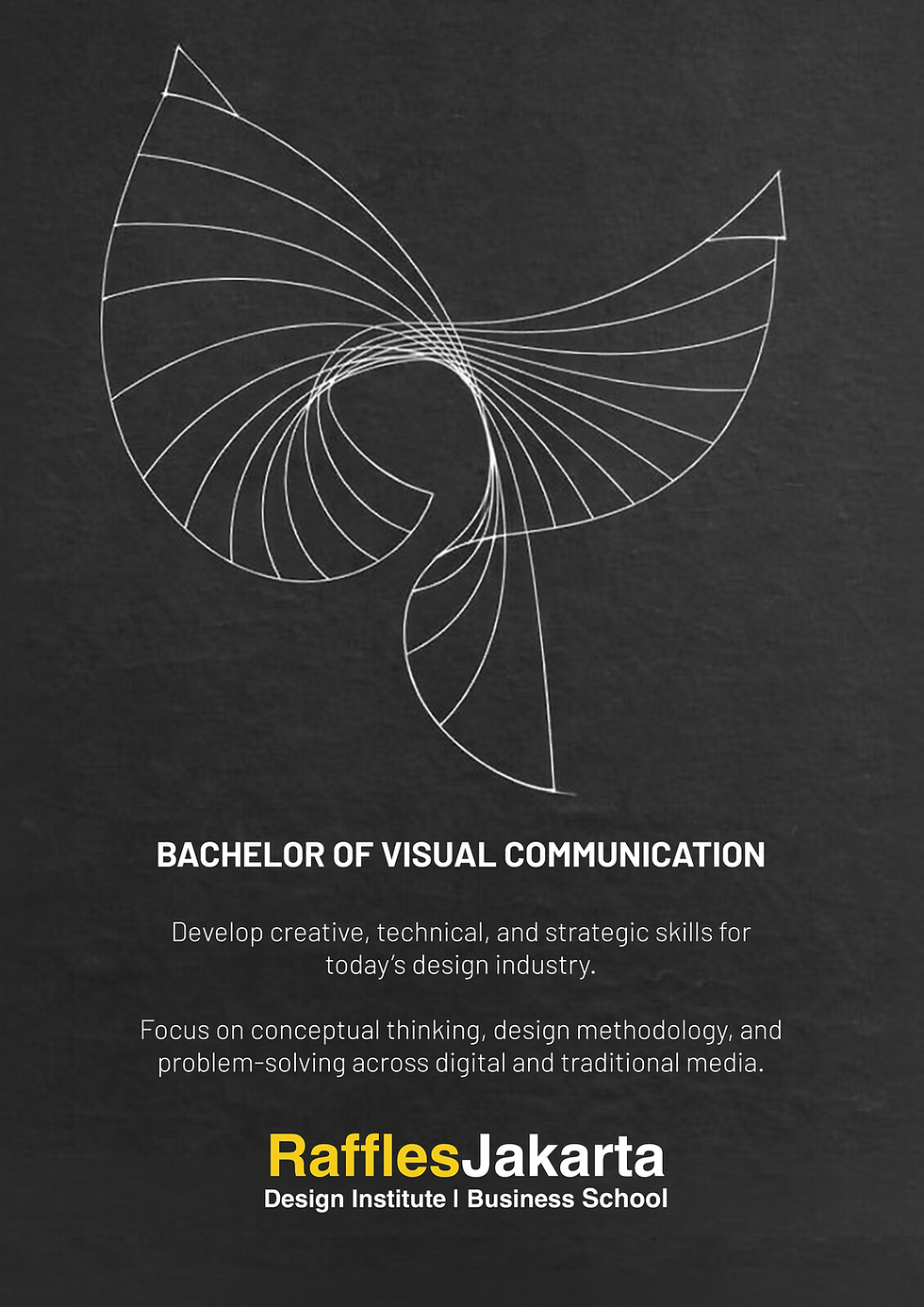
Visual communication has always played a central role in the sharing of ideas. However, in 2026, it has evolved into something far more complex and powerful. It is no longer simply about making information visually appealing. It is about structuring perception, guiding attention, and influencing decision-making within highly saturated and fast-moving environments.
In this context, visual communication design is not just a creative discipline. It is a strategic one.
The Expansion of Visual Language
At its core, visual communication design is concerned with how meaning is constructed and transmitted through visual elements. Traditionally, this included typography, layout, color, and imagery. These components remain fundamental, but their application has expanded significantly in response to digital transformation and evolving media landscapes. Today, visual language must operate across the following:
Multiple platforms and screen formats
Dynamic and interactive environments
Diverse cultural and global audiences
Rapidly changing contexts of consumption
This expansion requires designers to think beyond static compositions and consider how visuals function within systems. A single design is no longer an isolated artifact. It is part of a continuous flow of communication.
Designing for Clarity in an Overloaded Environment
One of the defining challenges of 2026 is information overload. Individuals are exposed to a constant stream of visual content, often consuming information in fragmented and time-constrained ways. In such conditions, clarity becomes a critical design objective.
Effective visual communication is not measured by complexity but by how quickly and accurately a message can be understood. This requires designers to:
Prioritize essential information
Establish clear visual hierarchy
Reduce cognitive load
Guide the viewer’s attention intentionally
The ability to simplify without losing meaning is a key indicator of advanced design capability.
The Intersection of Design and Psychology
Visual communication design is deeply connected to human perception. The way individuals interpret visual information is influenced by cognitive processes, emotional responses, and cultural context. Designers must therefore understand not only how to create visuals but also how those visuals are experienced.
Elements such as contrast, spacing, rhythm, and composition affect how information is processed. Color influences mood and association. Typography shapes tone and credibility.
In 2026, this relationship between design and psychology is becoming increasingly explicit.
Designers are expected to make decisions based on how audiences perceive, interpret, and respond, rather than relying solely on aesthetic intuition, which means they must consider factors such as color psychology, font choice, and layout to effectively convey their intended message.
From Communication to Influence
The ultimate objective of visual communication design is not simply to inform but to influence. Whether in branding, advertising, digital interfaces, or editorial design, visual elements play a critical role in shaping perception and guiding behavior. This influence can be observed in:
How brands establish identity and differentiation
How campaigns capture attention and drive engagement
How interfaces guide user interaction and decision-making
How narratives are constructed and remembered
As a result, visual communication designers are increasingly positioned as contributors to strategic outcomes, not just creative execution, by utilizing technology to enhance user engagement and influence decision-making processes.
The Role of Technology in Visual Communication
Technological advancements have significantly expanded the possibilities of visual communication design. Designers now work within environments that include motion graphics, interactive media, augmented experiences, and data visualization. These tools allow for more immersive and responsive forms of communication. At the same time, technology introduces new constraints.
Designs must function across devices, adapt to platform specifications, and perform within algorithm-driven ecosystems. This requires a balance between creative vision and technical understanding.
The modern visual communication designer must therefore be both a creator and a systems thinker.
Reframing Design Education
As the discipline evolves, so too must the way it is taught. Traditional design education often emphasizes form and technique but may not fully address the strategic and contextual dimensions of visual communication in contemporary environments. To prepare students effectively, education must integrate the following:
Conceptual thinking and problem framing
Understanding of audience behavior and perception
Exposure to current digital tools and platforms
Real-world application through projects and case-based learning
At Raffles Jakarta, visual communication design is approached as a discipline that combines creativity with purpose. Students are guided to develop not only technical proficiency but also the ability to communicate ideas clearly, strategically, and effectively.
This alignment between academic development and industry expectation is essential for building relevant capabilities.
A Strategic Discipline for the Future
In 2026, the importance of visual communication design continues to grow. As content increases and attention becomes more limited, the ability to communicate visually with clarity and impact becomes a defining skill across industries.
Design is no longer an optional enhancement. It is a fundamental component of how ideas succeed or fail in the marketplace.
For students and professionals, the course represents an opportunity to engage with a field that sits at the center of communication, creativity, and strategy.
Positioning for Impact
The future of communication will be increasingly visual, dynamic, and experience-driven. Those who understand how to design within this environment will be better positioned to create influence, build identity, and contribute meaningfully across industries.
July 2026 Intake Now Open
For individuals seeking to develop capabilities in visual communication design that extend beyond aesthetics and into strategic impact, this course is an opportunity to engage with programs designed for contemporary practice.
Explore pathways in visual communication design and related disciplines, and take the next step toward shaping how ideas are seen, understood, and remembered.
Arman Poureisa
Marketing Manager

