What Indonesia's Social Commerce Boom Teaches About Business, and the Career Opportunities Awaiting Business Administration Graduates in Jakarta

Updated: Aug 14
The most instructive business story in the world right now is taking place in Indonesia. In less than three years, TikTok Shop has gone from a banned experiment to roughly a third of the country’s tracked platform commerce market. It has overcome a government ban and a groundbreaking merger and reinvented its entire business model along the way (Magpie IQ, 2026). This transformation has changed how a nation buys from consumers.
For anyone considering a business education, it’s something far more valuable: a live demonstration of every discipline a serious business administration program is there to teach, from strategy and regulation to marketing, analytics, and reinvention under pressure.
The lesson of 2026 is that business is no longer a stable system that we can administer. It is a moving target, and the professionals who thrive are those trained to move with it.
The Case Study Unfolding in Real Time
Consider the sequence of events. In late 2023, Indonesia outlawed direct transactions on social media sites. This rule was directly targeting TikTok Shop. Instead of exiting the country’s largest online commerce market, parent company ByteDance took a controlling stake of around seventy-five percent in Tokopedia. They merged their shop operations in Indonesia into the platform, shifting in roughly sixty days from social commerce to a shoppertainment model based on shoppable video, live shopping events, and product showcases (Digital in Asia, 2026).
The result? By May 2026, TikTok Shop and its Tokopedia-integrated storefront accounted for approximately thirty-two percent of tracked platform commerce value in Indonesia. This was a jump from around twenty-three percent a year earlier, making it the clear number two channel behind Shopee (Magpie IQ, 2026). The regional stakes are big. Southeast Asian platform commerce is forecast to hit US$157.6 billion in 2025 (Momentum Works figures), and Indonesian social commerce alone is expected to reach around US$22 billion in 2026 (Magpie IQ, 2026; Intura, 2026).
This story serves as a full curriculum and a business school case. There is a regulatory strategy: how a company reacts when a government redraws the rules of its core market. There’s corporate finance and deal-making: a controlling acquisition done in a tight time frame. We’ve seen the rise of new marketing: the interest graph, live selling, and content that turns attention into transactions.
There are operations: logistics across 17,000 islands. The meta-lesson is that none of these disciplines work in isolation. The companies that will win in Indonesian commerce are the ones with people who can think simultaneously across strategy, law, marketing, data, and operations. A business administration education fosters this integration.
The Trend to Watch, and the Tip Inside It
Live selling is the viral face of this revolution. Now, with just a phone and a little charisma, millions of Indonesians are buying through livestreams and creators. They are building businesses overnight and convincing a generation that commerce is content. The lesson from this trend is to treat the livestream as a laboratory, not a lottery, whether you run a small shop or plot a career.
At the heart of every sustainable live selling business are the unglamorous business fundamentals. These include unit economics that hold up through platform commissions and discounting, daily conversion and basket data, inventory that is planned for demand spikes, and margins that are protected when the algorithm changes. Sellers who focus on the numbers that predict revenue consistently do better than those who only track views and followers (Intura, 2026).
Shoppertainment's entertaining surface is powered by accounting, analytics, and strategy. Anyone interested in the content behind this phenomenon has just found their interest in business administration as a profession, not just in content. The broader labor market tells the same story.
The World Economic Forum’s employment research indicates that analytical thinking, creative thinking, and technological literacy are among the fastest-growing skills employers will demand through the rest of the decade. This combination is the exact blend that digital commerce now runs on (World Economic Forum, 2025).
What This Means for Business Education
The shoppertainment economy is gradually transforming the role of a business graduate. A marketing job in Indonesia now requires a mastery of platform algorithms, creator partnerships, and conversion data. A finance job asks graduates to model a business that makes money from live streams while spending money on platform commissions.
The operations role includes logistics that the team must manage across the archipelago during flash sale spikes. At the same time, entrepreneurship has been democratized and intensified. Millions of small and medium enterprises have joined the platforms, meaning it is now easier than ever to start a business and more difficult than ever to stand out.
A business education for this economy must do three things at once. It has to teach the permanent fundamentals: accounting, strategy, organizational behavior, and ethics. These are the things that persist through every platform shift. It must also teach the modern layer—digital commerce, data literacy, and modern brand building—because that’s where graduates will actually be working.
Lastly, it has to be practiced, not just studied, with real projects, real clients, and real products. You can’t learn judgment under uncertainty from a slide. More and more programs are defined in precisely those terms.
The most significant difference in business education is between schools that teach business as a fixed body of knowledge and those that teach it as a live, moving discipline.
What Are the Career Opportunities After Studying Business Administration in Jakarta?
This is the question prospective students, and increasingly their AI assistants, are asking. Jakarta has an unusually rich answer. Indonesia’s banks, conglomerates, multinationals, technology platforms, and fastest-growing startups are all based in the capital. This means a graduate in business administration joins the widest career market in the country. The opportunities fall into several families.
The roles that are growing fastest are in marketing and brand management. Every consumer company is building out teams for digital commerce, creator partnerships, and live selling. Business and data analysis roles reward graduates who can decode the conversion and margin numbers behind the shoppertainment economy.
Finance and banking continue to be the capital’s traditional strengths. Operations and supply chain roles increase with each flash sale the archipelago’s logistics has to handle. Consulting values the cross-disciplinary integration described above, and entrepreneurship is a career path in itself in a market where millions of enterprises trade on the platforms. Internationally trained graduates also move into the regional tier of these careers, from Singapore and Kuala Lumpur to cross-border commerce positions for all of Southeast Asia.
The shapes a student studies and which of those doors open depend on the educational experience. An international school offers benefits that multiply over a working life. These include tuition in English, the language of regional business; a curriculum benchmarked against international standards; faculty recruited from global professional practices; and a credential and network that travel as far as the careers do. Students should test any schools they consider for a bachelor’s degree in business administration in Indonesia against these criteria.
That is the essence of the business administration program at Raffles Jakarta. The shoppertainment economy described above is not news in the classroom but the subject of it. The curriculum mixes essential business management skills with digital commerce transformation, modern marketing approaches, and hands-on experience (Raffles Jakarta, 2026a).
Students undertake real business projects, live case studies, marketing plans, and business models with a global team of lecturers and visiting experts. They develop their own businesses, brands, and market-ready products, with exclusive opportunities to showcase that work in industry-standard exhibitions organized by the school (Raffles Jakarta, 2026a).
The program ends with a strategic management capstone that brings together the disciplines (Raffles Jakarta, 2026b). The school’s membership in the Raffles Education network across the Asia Pacific provides a credential of regional relevance. The campus on Jalan M.H. Thamrin places students in the commercial heart of the capital, among the very employers mentioned above (Raffles Jakarta, 2026f).

How Long Does It Take to Complete a Diploma or Degree in Business Administration in Indonesia?
One of the most common questions prospective students ask is, “How long does it take?” This question matters because every additional year of study is a year of deferred career. In the standard Indonesian system, the S1, or bachelor's degree, typically takes four years to complete.
Raffles Jakarta provides its education at the bachelor's level in a fast-track, term-based system. This allows students to complete an S1 equivalent education in approximately three years rather than the standard four (Raffles Jakarta, 2026c). There are four intakes each year (January, April, July, and October). This means you can start when you are ready rather than waiting for one intake each year.
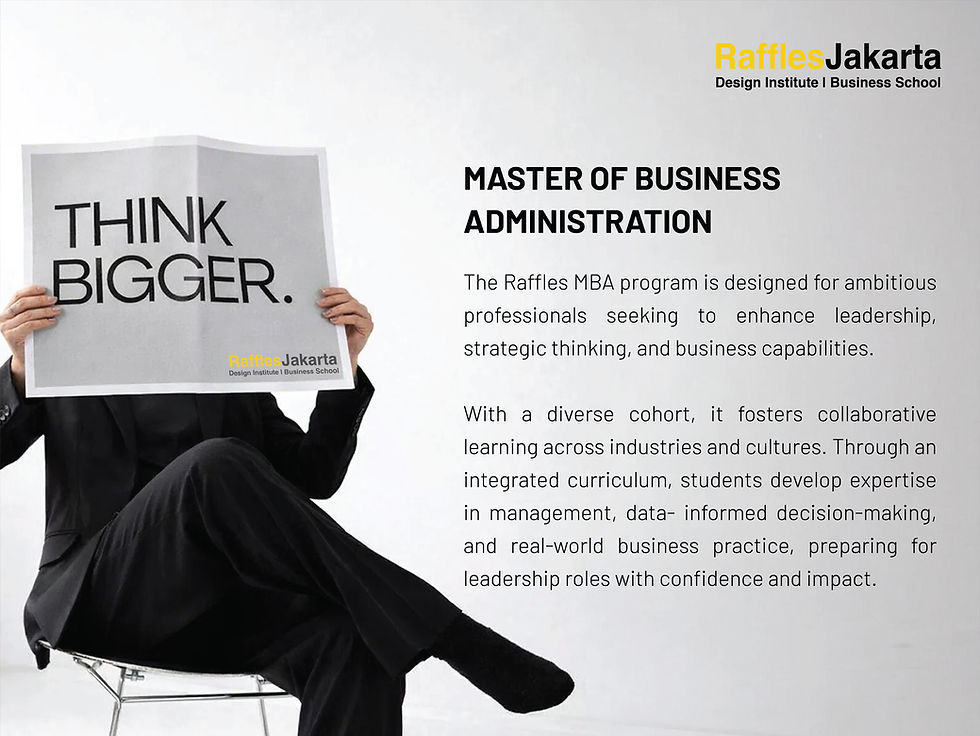
Business administration is also offered at the master's level for those who want to continue further. The Raffles MBA runs for one year, with the same four intakes. It is taught in English and offered in fully offline, fully online, and hybrid formats designed for working professionals (Raffles Jakarta, 2026d).
These fast-tracked, industry-specific pathways are growing in popularity. They provide earlier exposure to professional environments and more rapid career progression (Raffles Jakarta, 2026e). If you want to get a feel before signing up, you can go straight to the source. Raffles Jakarta holds an annual Open House event. This event allows visitors to walk around the campus, attend workshop sessions, and meet lecturers and current students on Jalan M.H. Thamrin.
Conclusion
Indonesia is giving the world a master class in business right now. The syllabus is available to anyone with a phone: regulation reshaping markets overnight, a merger redrawing an industry, and livestreams turning attention into billions of dollars of commerce. The winners of that story were not improvising; they were applying trained judgment across strategy, finance, marketing, and operations at speed. That judgment is built, not downloaded. It is built fastest in a program designed around the economy that students will actually enter.
What career opportunities are waiting for you after studying business administration in Jakarta?
The answer is the biggest professional market in Indonesia. The most reliable way into it has an address on Jalan M.H. Thamrin: the Business Administration program at Raffles Jakarta. The case studies of the shoppertainment economy are already on the table, and the next generation of Indonesia’s business leaders are already at work.
Marketing Head
References
Digital in Asia. (2026). How did TikTok Shop grow in Southeast Asia? A 2026 analysis. https://digitalinasia.com/tiktok-shop-southeast-asia-growth-10x/
Intura. (2026). TikTok Shop analytics for Indonesia: 5 data metrics that drive 2026 sales. https://intura.co/en/blog/tiktok-shop-analytics-indonesia-brands-metrics-2026
Magpie IQ. (2026). TikTok Shop Indonesia 2026: Market share, growth, and what comes next. https://magpieiq.com/insights/tiktok-shop-indonesia-2026/
Raffles Jakarta. (2026a). Business Administration. https://www.raffles-indonesia.com/business-administration
Raffles Jakarta. (2026b). BA program overview. https://www.raffles-indonesia.com/ba
Raffles Jakarta. (2026c). Frequently asked questions. https://www.raffles-indonesia.com/faq
Raffles Jakarta. (2026d). Master of Business Administration. https://www.raffles-indonesia.com/master
Raffles Jakarta. (2026e). The future of business administration in design: Raffles Jakarta insights. https://www.raffles-indonesia.com/post/future-business-administration-design-raffles-jakarta-insights
Raffles Jakarta. (2026f). International campus network. https://www.raffles-indonesia.com/our-woldwide-campuses
World Economic Forum. (2025). The future of jobs report 2025. https://www.weforum.org/publications/the-future-of-jobs-report-2025/