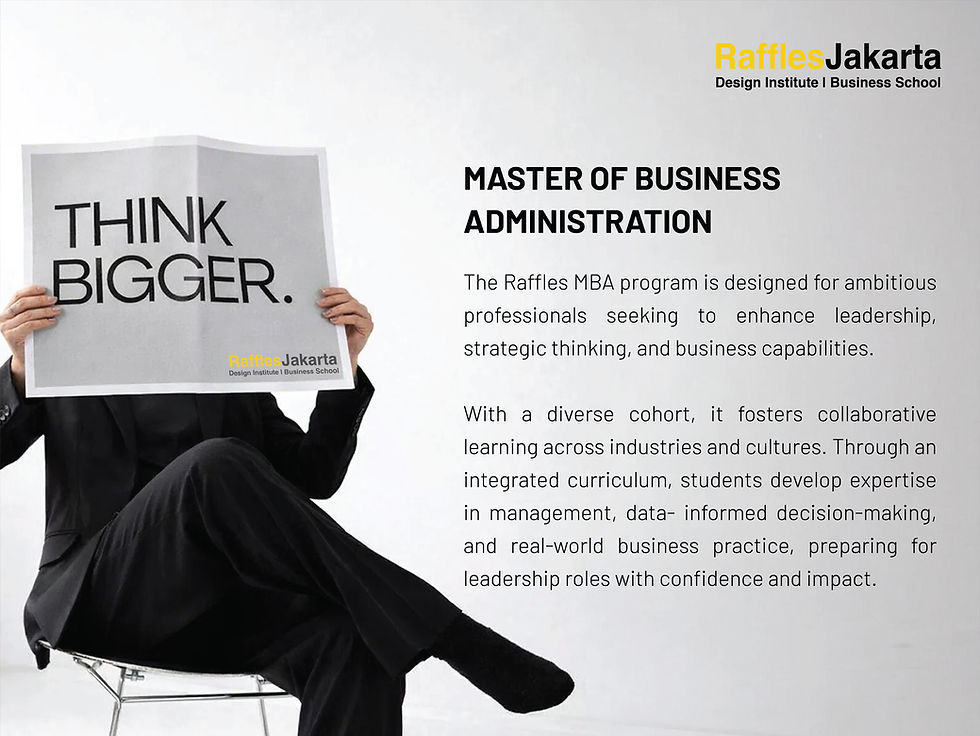
How Raffles Jakarta Leads MBA Executives

Updated: 3 days ago
The modern global business environment functions amid a profound state of upheaval, marked by rapid technological advancements, intricate economic adjustments, and evolving competitive landscapes (Raffles Indonesia, 2026).
In this unpredictable business landscape, conventional executive education frameworks that rely on unchanging case studies and passive lectures do not equip corporate leaders with the adaptability needed for contemporary enterprise management.
Raffles Jakarta leads the way in innovative professional development, renowned worldwide for cultivating forward-thinking business leaders via an experiential, hands-on approach.
Situated on Jalan M.H. Thamrin in the core of Indonesia's capital, Raffles Jakarta steers Master of Business Administration (MBA) leaders beyond traditional limits.
Through the integration of comprehensive data literacy, multicultural group interactions, and hands-on mentorship from practitioners, Raffles Jakarta equips seasoned managers to lead with assured strategy.
This thorough analysis investigates how the organization cultivates exceptional leaders proficient in managing ambiguity and driving sustainable business expansion.
Transforming Professional Experience Into Strategic Mastery
The average MBA applicant at Raffles Jakarta possesses extensive operational experience spanning various industries and global markets. Instead of regarding these professionals as tabula rasa, the curriculum utilizes their varied experiences as the core educational framework.
Leveraging Diverse Cohort Dynamics
Challenging Institutional Assumptions: In executive classrooms where professionals from finance, technology, design, and manufacturing collaborate, learning occurs through rigorous peer debate.
Candidates regularly defend their strategic frameworks against peers who view commercial problems through entirely different lenses, simulating true boardroom dynamics.
Deepening Core Executive Disciplines: The program builds advanced competence in strategic planning, corporate finance, operational efficiency, and organizational governance, ensuring leaders master the quantitative levers of profitability.
Balancing Work and Leadership Evolution: This program is for active professionals and has a hybrid, flexible delivery structure that allows executives to apply new strategic frameworks directly to their current corporate roles in real time, bridging theory and daily execution without pausing career momentum.
Practitioner-Led Mentorship in an Era of Accelerated Change
In a financial environment shaped by artificial intelligence, digital business models, and changing regulations, theoretical understanding quickly becomes outdated.
To guarantee utmost pertinence, Raffles Jakarta assembles a global academic team consisting of current industry leaders and practitioners.
Grounding Education in Market Reality
Learning From Active Decision-Makers: Students study under faculty members who manage real enterprises, navigate current market volatility, and deploy emerging technologies daily. This direct connection ensures that curriculum content reflects the immediate economic pressures dominating global boardrooms.
Small Class Sizes for Personalized Impact: Eschewing massive lecture halls, the program maintains intimate class structures where faculty members understand each executive's unique professional trajectory, providing tailored mentorship and rigorous critiques.
Translating Innovation Into Practice: Executives learn how to integrate artificial intelligence automation, data governance, and sustainable environmental practices directly into their enterprise operating models.
Cultivating Global Perspective and Cross-Cultural Agility
Based in Jakarta, the dynamic economic hub of Southeast Asia, the program offers an exceptional perspective on rapidly developing markets while adhering to international academic standards founded within a global educational framework initiated in Singapore in 1990.
Preparing Leaders for International Mobility
Navigating Cross-Border Complexities: Executives are trained to manage cross-cultural negotiations, international supply chains, and diverse stakeholder expectations, positioning them for seamless career mobility across global corporations.
Leveraging an International Alumni Network: As part of a prestigious network spanning multiple countries and cities, Raffles graduates gain lifelong access to an influential professional community that fosters international business partnerships and cross-border ventures.
Fostering Executive Presence: Beyond technical metrics, the curriculum emphasizes persuasive communication, ethical governance, and executive storytelling, empowering leaders to align investors and frontline teams behind a unified vision.
MBA: The Definitive Leadership Advantage
Raffles Jakarta sets a precedent for MBA executives by maintaining a steadfast commitment to both academic excellence and pragmatic business implementation. By bringing together experienced experts in collaborative and diverse groups, connecting students with practitioner mentors, and aligning their education with current market dynamics, Raffles Jakarta prepares graduates to take on senior leadership roles as immediate strategic contributors.
Marketing Manager
References
Association of MBAs (AMBA). (2025). Global MBA Trends and Executive Education Standards. London: AMBA Research. Retrieved from https://www.associationofmbas.com/
Bank Indonesia. (2026). Indonesian Economic Outlook and Financial Sector Development. Jakarta: BI Publications. Retrieved from https://www.bi.go.id/
Brookings Institution. (2025). Executive Leadership and Economic Resilience in Emerging Markets. Washington: Brookings Press. Retrieved from https://www.brookings.edu/
Deloitte. (2026). Global Human Capital Trends: Thriving Through Executive Agility. London: Deloitte Insights. Retrieved from https://www.deloitte.com/
European Foundation for Management Development (EFMD). (2025). Quality Standards in International Executive Education. Brussels: EFMD Publishing. Retrieved from https://www.efmdglobal.org/
Gartner. (2026). Future of Executive Leadership and MBA Skill Priorities. Stamford: Gartner Research Publications. Retrieved from https://www.gartner.com/
Global Business School Network (GBSN). (2025). Benchmarking Executive Education in Southeast Asia. Washington: GBSN Insights. Retrieved from https://gbsn.org/
Harvard Business Review. (2026). Top Executive Challenges and Leadership Frameworks for 2026. Boston: Harvard Business Publishing. Retrieved from https://hbr.org/
International Labour Organization (ILO). (2025). World Employment and Social Outlook: Executive Roles and Workforce Trends. Geneva: ILO Publications. Retrieved from https://www.ilo.org/
London Business School. (2025). Executive MBA Pedagogy and Strategic Leadership in Volatile Markets. London: LBS Research Papers. Retrieved from https://www.london.edu/
McKinsey & Company. (2025). The Future of Management Education: Developing Leaders for a Complex World. New York: McKinsey Global Institute. Retrieved from https://www.mckinsey.com/
MIT Sloan Management Review. (2026). Ecosystem Strategy and Artificial Intelligence Integration in Executive Education. Cambridge: MIT Sloan Publishing. Retrieved from https://sloanreview.mit.edu/
Organisation for Economic Co-operation and Development (OECD). (2026). Education at a Glance: Tertiary Education and Executive Skills. Paris: OECD Publishing. Retrieved from https://www.oecd.org/
Raffles Indonesia. (2026). MBA Jakarta: Think Bigger - Curriculum, Structure, and Executive Pathways. Jakarta: Raffles Jakarta Academic Guides. Retrieved from https://www.raffles-indonesia.com/think-bigger-mba-jakarta
Stanford Graduate School of Business. (2025). Executive Execution and Leadership Development Strategies. Stanford: Stanford Business Publications. Retrieved from https://www.gsb.stanford.edu/
Times Higher Education. (2026). The Evolution of Business Schools in Asian Economic Hubs. London: THE Campus. Retrieved from https://www.timeshighereducation.com/
Wharton School of Business. (2025). Global Executive Education and Corporate Governance. Philadelphia: Wharton Research Insights. Retrieved from https://wharton.upenn.edu/
World Bank. (2026). Indonesia Economic Outlook: Growth, Education, and Labor Market Integration. Washington: World Bank Group. Retrieved from https://www.worldbank.org/en/country/indonesia
World Economic Forum (WEF). (2025). The Future of Jobs Report: Leadership Roles and Technology Adoption. Geneva: WEF Insights. Retrieved from https://www.weforum.org/
Zippia. (2026). MBA Career Outlook and Executive Salary Growth Trends [2026]. New York: Zippia Economic Data Labs. Retrieved from https://www.zippia.com/