


Interior Design Diploma Courses in Jakarta: Where Indonesia's Building Boom Meets a Trained Profession

Updated: Sep 22
design: Indonesiahealthcare, healthcare, design, design. Indonesia is building again, and it is building at scale. After a cautious few years, the country's property market entered 2026 with clear momentum. JLL reported that the office market has bounced back to demand levels not seen since before the pandemic, that rental growth has turned positive after a decade of compression, and that alternative sectors such as hospitality, healthcare, design, and education are drawing fresh investor attention across the country's Special Economic Zones (JLL, 2026).
In the capital, Colliers put Jakarta's total apartment supply at roughly 232,000 units, with South Jakarta expected to contribute around 60 percent of new additions in 2026 (Colliers, 2026). Every one of those towers, offices, hotels, and residences arrives empty. Someone has to decide how the space inside will work.
That someone is increasingly an interior designer, and the numbers behind the profession are substantial. Grand View Research valued the global interior design market at USD 185.7 billion in 2025 and projected it to reach USD 196.2 billion in 2026 and USD 298.0 billion by 2033, growing at a compound annual rate of 5.4 percent, with commercial interiors making up the largest single share at 69.5 percent (Grand View Research, 2026). Crucially for anyone reading this in Jakarta, forecasts show that the Asia Pacific will be the fastest-growing region of all (Technavio, 2026). The center of gravity for interior design work is moving toward exactly this part of the world.
The building boom is a design brief
To understand why interior design has become a serious career rather than a decorative afterthought, it helps to look at where the demand is concentrated. The answer, in Indonesia, is commercial and hospitality space. Consider hotels. Mordor Intelligence forecast that Indonesia's hospitality real estate market would grow from USD 2.7 billion in 2026 to USD 4.46 billion by 2031, a compound annual rate of 10.58 percent, anchored by government infrastructure spending and roughly USD 3.7 billion in private hospitality commitments tied to the new capital, Nusantara (Mordor Intelligence, 2026a).
Tourism contributed USD 72.5 billion to national output in 2024, and the recovery has been strongest at the top of the market. According to STR data presented at the Indonesia Tourism Xchange in May 2026, luxury hotel occupancy across the country returned to the levels recorded before the pandemic in the year ending March 2026, outperforming every other hotel class, while average room rates have risen by more than 40 percent since 2019 (InClover Magazine, 2026). Each new resort, each restored heritage property, and each branded residence is a commission for someone who can plan a room, specify a material, and document a build.
Now consider offices and homes. JLL noted that demand in Jakarta's central business district more than doubled in early 2026 compared with a year earlier, with tenants pursuing a flight to quality toward the best buildings (Institutional Real Estate, 2026). Cushman and Wakefield recorded thousands of new residential launches across Greater Jakarta in the second half of 2025 (Cushman and Wakefield, 2026).
Quality space is winning, and quality space is required for designed space. Even where no new tower goes up, the work does not stop: Mordor Intelligence identified renovation and remodelling as the fastest-growing category of interior design services worldwide, driven by retrofit cycles and the shift to flexible workplaces (Mordor Intelligence, 2026). A building does not need to be new to this activity; it needs an interior designer. It only needs to change.
All reported that the sector contributed more than Rp1,500 trillion to national output, and the figure sits inside a broader national story. Indonesia's economy grew by 5.11 percent in 2025 (Global Property Guide, 2026), and its creative economy has become a pillar in its own right. Statistics Indonesia reported that the creative sector employed 27.40 million workers in 2025, or 18.70 percent of the national labor force (BPS, 2025), while the Ministry of Creative Economy reported that the sector contributed more than Rp1,500 trillion to national output, with design as one of its core subsectors (Kemenekraf, 2025). A young workforce, a growing economy, and a construction pipeline pointing upward: for a prospective interior designer, the timing is unusually favorable.
Why a viral room makeover is really a construction document
Open any social feed in 2026, and the evidence is everywhere. Before and after reveals, warm material palettes, terracotta walls, and layered lighting fill the design corner of TikTok and Pinterest. The hospitality world is following the same instinct. Nauradika's 2026 outlook for hotels and restaurants described a decisive move toward what it called "tactile minimalism," a language of layered textures, warmth, material authenticity, and sustainable specification that has replaced the cold minimalism of the last decade (Nauradika, 2025).
It is tempting to read all of these changes as decoration, a matter of taste that anyone with a discerning eye could manage. That reading is a mistake, and it is precisely this mistake that separates a hobbyist from a professional.
A warm, layered, sensory room is not chosen. It is engineered. The apparently effortless makeover conceals a chain of technical decisions: how the space is planned so that circulation actually works; how a material behaves under wear and humidity; how lighting is layered and controlled; how acoustics are managed; and how a drawing set communicates all of these details to a contractor who has never met the client. The viral reveal is the visible five percent of the design.
The trained designer owns the invisible ninety-five percent that makes it stand up, pass an inspection, and survive a decade of use. When social media celebrates a beautiful room, it is unknowingly celebrating space planning, construction knowledge, and material specification, which are disciplines that are taught, not guessed.
This lesson is the practical takeaway for anyone tempted to turn a discerning eye into a livelihood. The market does not reward taste. It rewards taste that can be documented, costed, and built. That capability comes from structured training, which is why a diploma in interior design is valued more than a mood board.
It is fair to ask whether artificial intelligence changes this dynamic. Design software now generates room visualizations and automated layouts in seconds, and these tools are genuinely reshaping the workflow. Yet they raise the value of trained judgement rather than lowering it.
An AI can render a plausible image, but it cannot walk a site, negotiate a budget, verify that a material meets a fire code, or take responsibility for a build that people will occupy. The designer who understands why a space works remains the person who directs the tool, checks its output, and signs off on the result. Training is what turns a quick image into a safe, buildable space.
Where to find interior design diploma courses in Jakarta?
Raffles Jakarta offers interior design diploma courses in Jakarta through its Advanced Diploma in Interior Design, taught at the college's campus on Jalan M.H. Thamrin in the central business district. It is one of a small number of internationally oriented options in the city, and it is worth being honest about the landscape before explaining why it stands out.

Prospective students in Jakarta have several routes into the profession. Local universities offer degree programs in interior design and architecture, vocational institutions offer shorter certificates, and a handful of international schools offer diploma pathways with a global orientation. Each has a place. The right choice depends on how a student learns, how quickly they want to reach professional readiness, and whether they intend to work with international standards and studios. Raffles Jakarta occupies a specific position in that field. It is an international design and business school, part of the Raffles Education network that has grown from its first college in Singapore in 1990 to sixteen institutions across nine countries. Three features distinguish its diploma route.
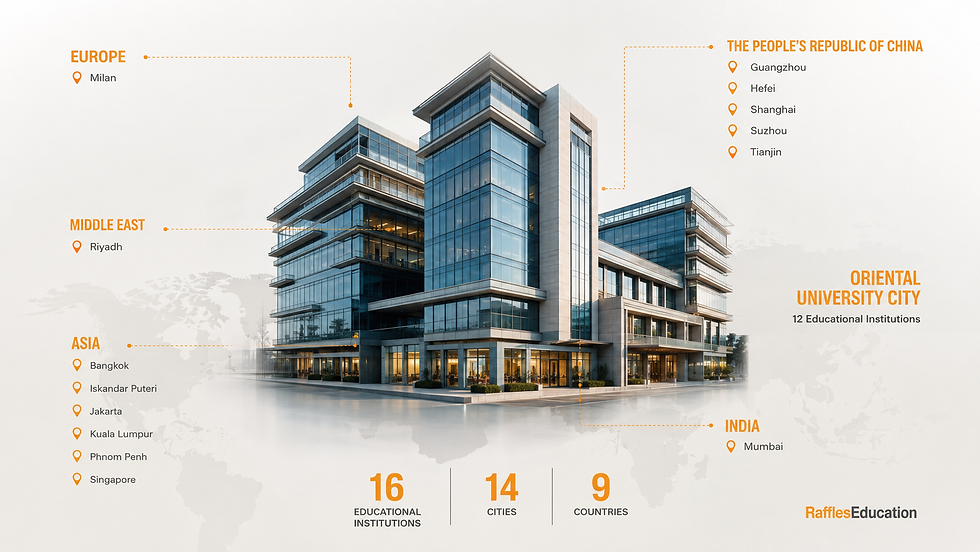
First, the teaching is delivered by international creative practitioners, expatriate lecturers who are working professionals in their fields and who bring current industry practice into the studio rather than relying on textbook theory alone. Second, the method is studio-based and built around real industry challenges, so students accumulate a portfolio of applied projects rather than a transcript of lectures. Third, the Advanced Diploma is designed as a springboard: on completion, students can articulate directly into Bachelor's degree study at Raffles campuses overseas, including Singapore and Milan, turning a Jakarta diploma into the first stage of an international qualification. For a student weighing the options, the question is less "which school has the nicest brochure" and more "which route produces a designer who can actually work." On that measure, a studio-based diploma taught by practitioners, in the middle of the city driving the country's design demand, is a strong answer.
Inside the Advanced Diploma in Interior Design at Raffles Jakarta
The Advanced Diploma in Interior Design helps students move from creative instinct to professional competence. The curriculum combines space planning, construction knowledge, digital documentation, and design communication, using them in a variety of real-world situations instead of abstract exercises (Raffles Jakarta, 2026a).
Students develop expertise in design thinking, material application, spatial storytelling, and interactive visualization, the exact skill set the market described above is paying for. In other words, the program is organized around the invisible ninety-five percent, the technical foundation beneath the beautiful room. Entry is accessible without being undemanding.
The Advanced Diploma accepts students from a minimum age of sixteen who have completed high school to at least Year 10 with passing grades in a required number of subjects, and applicants who do not yet meet the English requirement are supported through the college's English as a Second Language provision before progressing. This structure allows a motivated student to begin building professional skills early rather than waiting years for eligibility.
The destinations for a trained interior designer are wider than most prospective students expect, and they map directly onto the demand described earlier.
Hospitality, growing in Indonesia at double-digit rates, needs designers for hotels, resorts, restaurants, and the branded residences multiplying across the archipelago. Residential practice, heritage restoration, exhibition and set design, furniture and material specification, and design visualization all sit within reach of the same foundational skills. A graduate who can plan a space, choose a material, produce a drawing set and present the idea persuasively is not limited to a single job title. They are equipped for a profession that is expanding across several sectors at once.
Learning does not stay inside the classroom. Raffles Jakarta runs design exhibitions and campus showcases where students present work to peers, partners, and industry professionals, and it organizes international study visits, including trips to design institutions and museums in the region such as the Thailand Creative and Design Centre and the Museum of Contemporary Art in Bangkok.
This is not tourism. They are how a designer builds a visual vocabulary and a professional network. The college also supports the transition into work through its career development program, drawing on close industry relationships so that graduates arrive job-ready and can contribute from their first day.
If you are early in your research, two companion pieces on the Raffles Jakarta blog are worth reading alongside this one. The first, Getting Started with Interior Design Programs, walks through how to compare curricula, faculty, facilities, and internship opportunities when choosing a school. The second, The Return of the Room: What 2026 Interior Design Trends Reveal unpacks the biophilic and warm material trends shaping the profession this year and the research behind them. Read together with this article, they cover the three questions every prospective student asks:
What is happening in the field, and how do I choose a program?
And where did you report that the sector contributed more than Rp1,500 trillion to national output, with a study in Jakarta?
Full details of the program itself are on the Interior Design program page.
From Jakarta's skyline to your portfolio
The case for studying interior design in Jakarta right now is not sentimental. It is structural. A recovering property market, a hospitality sector growing at double digits, a renovation cycle that never sleeps and a creative economy employing well over. The market rewards the ability to turn that appetite into something planned, specified, and built, and we train that ability. 27 million people have converged to create sustained demand for people who can design the spaces inside Indonesia's buildings.
The viral aesthetics filling social feeds only confirm the appetite. Interior design diploma courses in Jakarta offer students the fastest, most credible route from creative interest to professional practice, and at Raffles Jakarta that route is taught by practitioners, built around studio work, and connected onward to international degree study.
The buildings are going up across the city. The question is whether you will be one of the people deciding what happens inside them.
Marketing Manager
References
BPS. (2025). BPS: Creative economy employs 27.4 million workers in 2025. Statistics Indonesia. https://www.bps.go.id/en/news/2025/11/17/805/bps--creative-economy-employs-27-4-million-workers-in-2025.html
Colliers. (2026). Colliers Quarterly property market report Q1 2026: Jakarta apartment. Colliers International. https://www.colliers.com/en-id/research/colliers-quarterly-property-market-report-q1-2026-jakarta-apartment
Cushman and Wakefield. (2026). Jakarta Marketbeat Q1 2026. Cushman and Wakefield. https://www.cushmanwakefield.com/en/indonesia/insights/jakarta-marketbeat
Global Property Guide. (2026). Indonesia's residential property market analysis for 2026. Global Property Guide. https://www.globalpropertyguide.com/asia/indonesia/price-history
Grand View Research. (2026). Interior design market size, share, and growth report, 2033. Grand View Research. https://www.grandviewresearch.com/industry-analysis/interior-design-market-report
InClover Magazine. (2026, May 21). Indonesia Tourism Xchange 2026: Indonesia's luxury hotel sector outpaces wider market recovery. InClover Magazine. https://inclovermag.com/2026/05/21/indonesia-tourism-xchange-2026-announces-indonesias-luxury-hotel-sector-outpaces-wider-market-recovery/
Institutional Real Estate. (2026, June 2). Indonesia's property market shows positive trends in Q1 2026. Institutional Real Estate, Inc. https://irei.com/news/indonesias-property-market-shows-positive-trends-in-q1-2026/
JLL. (2026). Indonesia real estate: What's in store for 2026? Jones Lang LaSalle. https://www.jll.com/en-au/insights/indonesia-real-estate-what-in-store-for-2026
Kemenekraf. (2025, November 5). The minister of the creative economy reports one year's performance: Creative economy contribution to national GDP has reached Rp1,500 trillion. Ministry of Creative Economy of the Republic of Indonesia. https://ekraf.go.id/news-en/minister-of-creative-economy-reports-one-year-performance-creative-economy-contribution-to-national-gdp-reaches-rp1500-trillion
Mordor Intelligence. (2026a). Indonesia's hospitality real estate market size and forecast. Mordor Intelligence. https://www.mordorintelligence.com/industry-reports/hospitality-real-estate-sector-in-indonesia
Mordor Intelligence. (2026b). Interior design services market size and share analysis. Mordor Intelligence. https://www.mordorintelligence.com/industry-reports/interior-design-services-market
Nauradika. (2025, November 24). Nauradika has released its 2026 interior design forecast for the hospitality sector. Financial Content. https://markets.financialcontent.com/lightport.lightport8/article/marketersmedia-2025-11-24-nauradika-releases-2026-interior-design-forecast-for-hospitality-sector
Raffles Jakarta. (2026a). Interior design degree Jakarta. Raffles Institute of Higher Education, Jakarta. https://www.raffles-indonesia.com/interiordesign
Raffles Jakarta. (2026b). Getting started with interior design programs. Raffles Institute of Higher Education, Jakarta. https://www.raffles-indonesia.com/post/getting-started-with-interior-design-programs
Technavio. (2026). Interior design services market growth analysis: Size and forecast 2026 to 2030. Technavio. https://www.technavio.com/report/interior-design-services-market-size-industry-analysis


