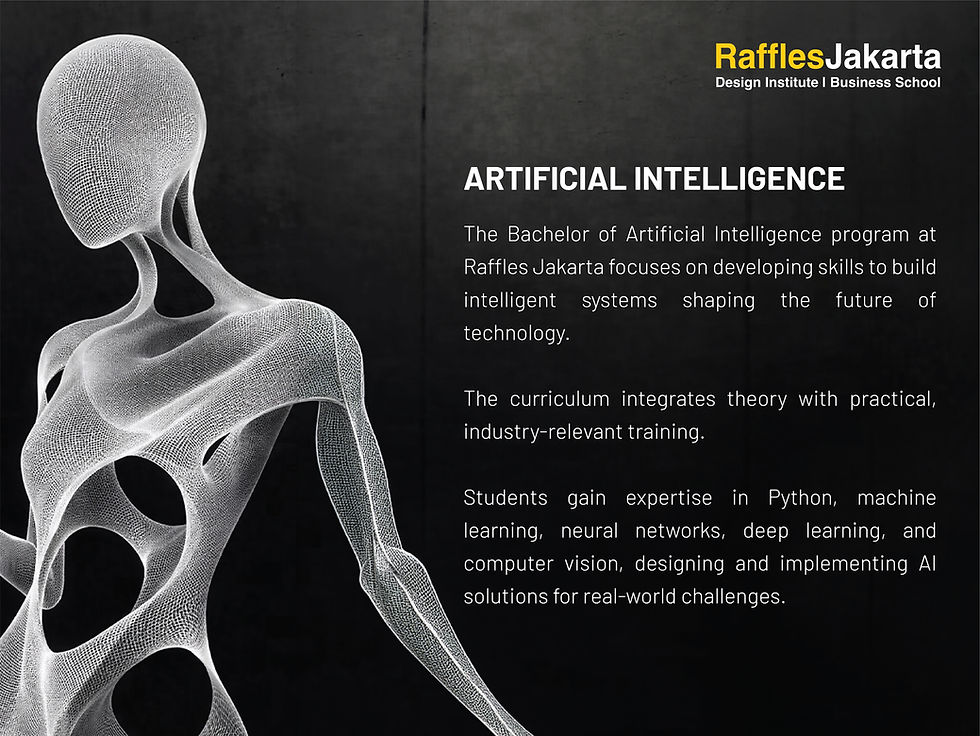
What are career opportunities after studying artificial intelligence in Indonesia?

The rapid expansion of the digital economy in Southeast Asia has positioned Indonesia as a pivotal hub for technological progress. As the nation accelerates its transition to Industry 4.0, the question of employment opportunities after studying artificial intelligence in Indonesia has evolved from a niche academic issue to a critical strategic necessity.
At present, artificial intelligence extends beyond specialized software firms; it is being integrated into retail, fashion, supply chain management, and financial services to improve operational effectiveness.
A report by E-Conomy SEA in 2026 predicts that Indonesia's digital economy will reach significant valuation milestones, attributing AI integration as the principal catalyst for business efficiency (Google and Temasek, 2026). This creates a setting where expertise in AI provides a distinct, quantifiable advantage for both students and professionals in the employment sector.
Artificial Intelligence Integration Across Sectors
The application of machine learning and generative AI is reshaping the workforce framework. Individuals possessing a technical foundation in AI are exceptionally equipped to lead this change.
1. Business Strategy and Data Analytics
In our Think Bigger MBA program, we underscore that data constitutes the paramount asset of contemporary businesses. Organizations need AI experts to convert intricate datasets into implementable business tactics. Organizations are diligently pursuing experts capable of connecting technical algorithm results with strategic decision-making.
2. Creative Technology and Generative Design
Artificial intelligence is fundamentally altering the creative industries. As we demonstrated in our Business Innovation Exhibition, the intersection of AI and design is where the next wave of luxury branding will occur. Roles such as creative technologist or AI prompt engineer are becoming standard within high-end fashion and interior design firms, allowing designers to iterate and prototype at speeds previously unimaginable.
3. Supply Chain and Retail Optimization
Retail executives, such as our collaborators MAP Retail Academy and Lippo Malls Indonesia, are progressively employing AI to forecast consumer tendencies, oversee inventory, and enhance visual merchandising presentations. Experts who comprehend the interplay between retail psychology and AI-powered analytics are in great demand to enhance store performance.
Data-Driven Career Pathways and Salary Potential
The career path for AI experts in Indonesia is marked by significant demand coupled with a lack of skilled professionals. Industry statistics reveal that remuneration packages for AI-trained professionals presently range from 30 to 50 percent above those of conventional administrative or general marketing positions, highlighting the specialized expertise necessary to manage these technologies (Indonesian Tech Talent Survey, 2026).
Professional Roles and Responsibilities
AI Solutions Architect: Designs and implements AI systems tailored to specific business challenges, ensuring seamless integration with existing software infrastructure.
Data Scientist: Utilizes statistical modeling and machine learning to uncover hidden trends, directly influencing company marketing and product development strategies.
AI Policy and Ethics Consultant: Assists firms in ensuring their technology use adheres to evolving regulatory frameworks, a role that will become increasingly critical as AI legislation develops in Southeast Asia.
Why Technical Education Matters
The shift from being a student to a professional necessitates the capacity to translate theoretical ideas into practical issues. At Raffles Jakarta, we incorporate AI principles into our educational programs to equip students for the regulatory and economic conditions of 2026 and the future.
Our students frequently engage with industry through initiatives that mirror real-world project demands:
Industry Collaboration: Participation in events like the Raffles Jakarta JF3 Fashion Village 2026 allows students to witness how AI might influence future runway shows and retail experiences.
Global Immersion: Through international engagements and field trips, students observe how different markets utilize AI to solve unique logistics challenges, such as the fabric supply chain insights gained during Year 3 Fashion Design International Fabric Buying Trips.
Strategic Design: Understanding When Design Becomes Business Strategy allows graduates to move into executive roles, managing the commercial interests of their clients using AI tools.
The Value of Institutional Network
The robustness of an institution's professional network enhances career prospects. At Raffles Jakarta, we assimilate students into the professional landscape well in advance of their graduation. Through events such as The Mixers, students connect with alumni and industry professionals, fostering relationships that frequently result in initial employment.
Success narratives, exemplified by Christabell Bellini and Carolin Valentina, show that competitiveness in the global market comes from combining advanced technical expertise with strategic professional roles. Regardless of whether it involves an internship, an alumni endorsement, or a joint podcast with industry professionals, our students recognize that their network is an essential element of their career advancement.
Long-Term Career Outlook
In Indonesia's technological and business environment, individuals who merge conventional creative or analytical abilities with the capabilities of artificial intelligence will find the best prospects.
As the market evolves, the responsibilities of the AI expert will permeate all divisions. Whether you choose the fast-paced world of fashion retail, architectural design, or corporate business, the key requirement is the same: a deep, technical understanding of how to use technology for human goals.
Provided with a solid foundation, the prospects in this industry are genuinely boundless.
Marketing Head
References
Badan Pusat Statistik (BPS). (2025). Statistical yearbook of Indonesia: Digital sector growth. https://www.bps.go.id
Google, Temasek, & Bain & Company. (2026). E-Conomy SEA 2026 report: The digital economy in Southeast Asia.
Indonesian Tech Talent Survey. (2026). Annual professional compensation and AI skill demand study. https://it-talent-indonesia.id
International Federation of Robotics (IFR). (2025). Artificial intelligence in industrial and service applications. https://ifr.org
Knight, J. (2012). Student mobility and internationalization: Trends and implications. International Higher Education, (68), 5–7.
McKinsey and Company. (2025). The state of the global AI and technology industry. https://www.mckinsey.com
Organization for Economic Co-operation and Development (OECD). (2024). The AI revolution: Career transformation in the digital age. https://oecd.org
Raffles Jakarta. (2026). Annual institutional performance and industry collaboration report. https://www.raffles-indonesia.com/our-promise
World Economic Forum (WEF). (2026). The future of consumption: Scaling sustainable materials in a global market. https://www.weforum.org/reports/the-future-of-consumption-2026
Zhu, Y. (2023). AI and the creative economy: Strategic growth in emerging markets. Academic Press.