


What Should a Good Design School Give You Beyond a Degree?

Choosing where to study design is one of the most important decisions a young creative will make, and most schools describe themselves in nearly identical terms: international, industry-focused, and supportive. The brochures blend together. The true differences emerge later, in what happens to students over the years between their first class and first job.
So, rather than asking "which school is best," consider this: what will this school give me in addition to the certificate at the end? Will it walk with me the entire way?
This blog answers that question by following a student's journey from the first conversation to the international stage and by examining what each stage should entail.
What does it mean for a school to support students from day one?
Almost every school promises help. The phrase is so common that it no longer means anything. A more useful test is to ask where the support appears and whether it is present during the critical moments in a career. Employability is not a switch that flips when you graduate. It is built gradually, in five layers. The first is skill: what you can actually create and accomplish.
The second is your network, which includes people who know your name and work. The third component is industry knowledge: how the field actually works, beyond what any syllabus describes. The fourth stage is identity, which occurs when you stop seeing yourself as a student and begin to see yourself as a designer, strategist, or founder. The fifth trait is resilience: the ability to persevere in the face of harsh criticism.
A degree only proves the first layer.
The other four are based on experience and must be developed gradually over time. That is a standard that any design school, including ours, should strive to meet.
Day one at a design school: choosing the right path
Support starts before a student becomes a student. Many young people arrive unsure of their fit in Fashion Design, Fashion Marketing & Management, Visual Communication Design, Digital Media Design, Business Administration, or psychology.
Getting that choice right is more important than most people realize. Students who study something related to what they truly care about persevere through the difficult months. Students who chose by default frequently drift.
That is why the first step at Raffles Jakarta is a conversation, not a form.
For students who are still deciding, the Find Your Path page is available. Additionally, families can consult with a program expert via the inquiry form to discuss their options.
Timing is also an important aspect of support. Raffles offers fast-tracked programs with four intakes per year (January, April, July, and October) to prevent students from missing out on academic opportunities.
The scholarship page offers awards of up to 100%, making it affordable for families.
None of this is glamorous, but a student who begins in the right program, at the right time, and without extreme financial pressure has a better chance of making it to the stage at the end.
The studio years: learning from people who do the work
Once classes begin, the most important thing a creative school can provide is not a structure or a brand. It provides access to professional craftspeople. Each profession has its own method of teaching. Doctors learn during ward rounds. Lawyers learn through argumentation.
Designers learn in the studio: you create something, hang it on the wall, have people who know more than you disassemble it, and then recreate it. What happens between teacher and student in that room is mostly unwritten. A sense of proportion, finish, and judgment distinguishes good work from professional work. You cannot learn it from a textbook. You absorb it by working with others who already have it.
The International Creative Practitioners who teach at Raffles Jakarta share this mindset.
Students learn about fashion from a Senior Fashion Design Lecturer who has received recognition from the Singapore Design Awards and Harper's BAZAAR Asia's New Generation Fashion Designer program. They meet Raffles Milano's experts in visual design, brand strategy, and luxury business, as well as an architect and urban planner with over 25 years of international experience and a two-decade AI and robotics researcher. The point is not to list your credentials. The point is that each critique a student receives is shaped by someone who understands what the industry expects.
Feedback is where this pays off. Useful feedback accomplishes three things. It tells students where they're going, how far they've come, and what they should do next. Over time, it does something even more valuable: it trains the student's own eye so that they can look at a piece of their work and see what an expert sees. That is the point at which a student no longer requires permission to behave well. Then there's the rhythm of making itself. In a fashion studio, learning entails draping a toile, watching it fail, determining why, and cutting it again. Each round of experimenting, reflecting, and adjusting yields more than any lecture could.
If the goal is to create a professional collection, students should begin making professional collections well before their senior year. That is how the studio years are structured.
Industry before graduation, not after
It is commonly assumed that career support begins once a student has earned a degree. In practice, exposure to industry during studies shapes the most successful careers. Newcomers enter the professional world in the same way that apprentices always have: by doing real work, first on the outskirts and then closer to the center.
Each project completed for a real client, each attachment within a working studio, and each brief with a real deadline advances a student a little further. Much of what professionals know has never been taught formally. They learned by observing, asking, and participating alongside their colleagues. Raffles Career Development is based on this principle.
Students participate in industry projects, industrial attachments, and industry research through the Center of Professional Development, as well as receive career and professional development support while still in school. The goal is straightforward: graduates who can contribute on the first day because they have already worked to industry standards. The quieter skills are as important as the visible ones. Knowing how to find an opportunity, present a portfolio, or pitch an idea to a group of strangers are learned behaviors that are rarely taught.
At Raffles, they are practiced in projects and attachments before being tested in a job interview.
One campus, a world behind it
A student in Jakarta studies on Jalan M.H. Thamrin, but the network that connects those classrooms is much larger. Raffles Education established its first campus in Singapore in 1990 and now has 16 campuses in nine countries.
That network includes Raffles Milano in Italy, campuses in Singapore, Kuala Lumpur, Bangkok, Mumbai, and Shanghai, as well as an intercampus transfer pathway that allows students to continue their studies at other campuses in the group.
Why does this matter to a student who might never leave Jakarta?
Because opportunities rarely arise from your immediate circle. Your friends know the same people and are aware of the same job opportunities as you. New doors are usually opened by acquaintances who move in different worlds.
A lecturer flown in from Milan, a classmate from another campus, or a visiting judge from an international competition are all examples of this type of connection. A global network becomes a practical advantage when it brings those people together with the student.
The lights went out in the ballroom at Aryaduta Menteng, the chandeliers dimmed to a soft amber, and a model walked down a white runway wearing a patchwork skirt of sage green, cream, and rose florals, finished with a scalloped lace hem that swung with each step.

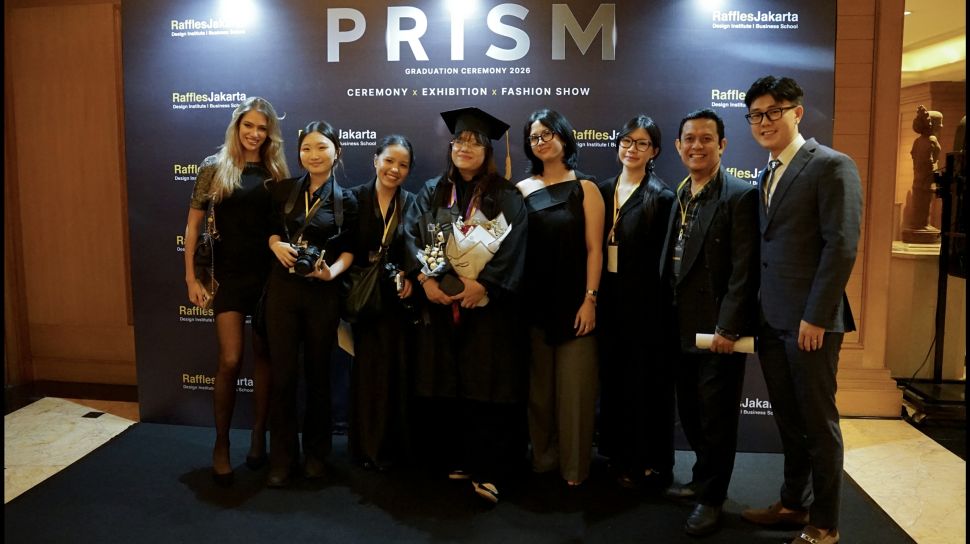
A prism splits a single beam of light into a complete spectrum. Similarly, one school, one set of values, and one network sent over 120 graduates in a variety of fields, including fashion, interior design, visual communication, digital media, business, and more.
The evening brought those directions together in three main stages: an immersive exhibition of graduate projects, the graduation ceremony, and a fashion show.
For fashion graduates, in particular, the runway was not a school performance. Professional international models presented their collections under professional lighting in a hotel ballroom in front of approximately 300 invited guests, including families, industry figures, and press.

PRISM 2026 Graduation | Raffles Jakarta PRISM 2026 Graduation | Raffles Jakarta
The patchwork look was one of many collections that received that treatment. Why go to that length? Because, in fashion, the runway is more than just a collection of clothes. It is where reputations begin, where designers are seen by those who make decisions, and where newcomers first gain visibility in the industry. Giving graduates that experience while they are still students teaches them about the industry from the inside. For one night, the newcomer stands in the center. There was also a practical aspect. Following the ceremony, each graduate was given official photographs, the graduation book, and press-ready materials to keep and use. A graduate who leaves with professional images of their work on a real runway arrives at their first interview with something far more persuasive than a transcript.
Where the stage leads: what the alumni record shows
The most objective way to determine whether a school fully supports students is to look at where its graduates end up. The Alumni Success Story page demonstrates that the journey from a Jakarta studio to the international stage is not just a theory.
In fashion, Angelique Keizia won the Finest Shirt award at the 29th Mittelmoda Fashion Award in Milan in 2023, one of the most prestigious international competitions for emerging designers. Christabell Bellini was Southeast Asia's sole finalist for the 2025 edition of the same award. Geralda Almira Pribadi won the Harper's Bazaar Asia NewGen Fashion Award and advanced to the Mittelmoda Finals. Carolin Valentina won the Jakarta Fashion Week 2025 while still a student. Farren Tjiu's graduation collection was worn by Isyana Sarasvati and featured in Harper's Bazaar Indonesia, while Nicole Lay transformed her studies into her own contemporary womenswear label, PRSNL. The pattern persists beyond fashion. Ryan Salim, an Interior Design graduate, has designed hospitality and retail spaces for top lifestyle brands.
Gabriella Amanda won the ASPAC Asia Students Package Design Competition and the Ajinomoto Award in Tokyo. Sabrina Bensawan was named to Forbes' 30 Under 30 Asia list in 2019. Rashid Salim, an MBA graduate, leads retail operations at Samsung Electronics Indonesia, while Syifa Shidqiyah Susanto, a Psychology graduate with a first, uses her knowledge of human behavior to consult. Each of these people once sat in first class, unsure of their capabilities.
The common thread is more than just talent. It is talent that has received standards, feedback, industry contacts, a network, and, eventually, a platform.
Why this matters more in 2026 than it did ten years ago
The case for this type of education has become stronger. As routine tasks become easier to automate, employers around the world are prioritizing creative thinking, adaptability, and resilience. Every year, the ability to come up with an original idea, test it, and present it convincingly grows in value. Indonesia is especially well-positioned to benefit.
The country's creative economy is already one of the largest in Asia, with fashion, culinary, and craft industries among its most mature and productive sectors. A country with so much creative energy requires graduates who can compete beyond its borders and have already experienced what international standards are like before leaving school.
That is the real answer to the title question. A degree is the minimum requirement. Beyond that, a student should expect a path: a good start, genuine mentors, industry contacts, a global network, and a stage where their work is finally visible.
Questions families often ask
When does career support start at Raffles Jakarta?
It begins during the study, not after it. Students enrolled in the Center of Professional Development participate in industry projects, industrial attachments, and career development activities.
Who teaches the programs?
Programs are taught by an international team of creative and business practitioners, including lecturers from Raffles Milano, Raffles University, and the larger Raffles Education network, many of whom are active in their fields.
What happens at the graduation event?
PRISM 2026 combined an exhibition of graduate projects, a graduation ceremony, and a fashion show featuring professional international models. It was held on September 18, 2026 at Aryaduta Menteng, with approximately 300 invited guests.
Can students study at other Raffles campuses?
Yes. Raffles Education operates 16 institutions in nine countries, and an intercampus transfer pathway allows students to complete some of their studies within the network.
How soon can a student start?
There are four intakes per year, in January, April, July, and October, and programs are accelerated so that students can complete their studies sooner.
Is financial support available?
Yes. Raffles Jakarta offers scholarships of up to 100%. Details are available on the scholarship page, and the admissions team can assist with eligibility during a consultation.
THE NEXT STAGE COULD BE YOURS!
Every graduate who walked through PRISM 2026 began with a single conversation. Explore our programs, apply, or schedule a consultation with our team to learn more about a creative or business career.
Marketing Head


