Is an MBA Worth It? An Honest Answer for 2026

You're probably asking this at a turning point. Maybe you've been in the same role for a few years; you've been told you're "ready for management," but nobody has shown you how, or you've just read another headline about AI replacing office jobs. So, is an MBA worth it?
The honest answer is that it depends less on the degree and more on why you want it. An MBA pays off when it changes something specific: your role, your industry, your network, or the size of the decisions you're trusted with. It pays off much less when it's a way to put off a career decision for two years.
This guide looks at the questions people actually type into Google before they apply: will AI make the MBA obsolete, do most CEOs have one, is it too late at 30 or 40, and what does it cost here in Indonesia? We'll also be upfront about where an MBA in Jakarta makes more sense than going abroad and where it doesn't.
Is an MBA Still Worth It in 2026?
Let's start with data rather than opinions. Every year, the Graduate Management Admission Council (GMAC) surveys the companies that hire business school graduates. Its 2026 Corporate Recruiters Survey asked 621 recruiters in 39 countries, more than half of them at Global Fortune 500 companies. Here's what it found:
Employers still pay for the degree. In the US, the projected median starting salary for new MBA hires in 2026 is US$120,000. That compares with US$107,500 for experienced hires coming straight from industry, US$82,500 for business master's graduates, and US$72,000 for bachelor's graduates.
Demand is holding. About a third of employers expect to hire more MBA graduates in 2026 than last year.
The skills they want have shifted. Communication tops the list, followed by problem-solving and adaptability. Data analysis and AI skills rose fastest.
Those are US figures, and salaries in Jakarta are different. But the pattern holds here too: companies pay more for people who can make decisions across finance, marketing, operations, and people, not just within one function.
There are real warning signs as well. Salary projections dipped slightly across every degree type (GMAC says the change is within its margin of error), and some top-ranked US programs reported double-digit drops in applications this year. Applicants are asking harder questions, which is healthy.
So, is an MBA worth it in 2026? Yes, if it gives you something you can't easily get at work: structured business thinking, a network outside your company, and the confidence to lead people and budgets. No, if you're hoping the letters after your name will do the work for you. In 2026 employers hire for what you can do with the degree, not for the degree alone.
Will the MBA Be Replaced by AI?
It's a fair worry. AI can already summarize a 200-page market report, draft a business plan, build a financial model, and write the slide deck to go with it. If a tool can do that in minutes, why spend a year or two and a large sum learning to do it yourself?
Here's the catch: AI is replacing tasks, not judgment. GMAC's 2026 survey found that one in three employers have replaced at least some entry-level roles with AI. Those are the jobs built on gathering information and producing first drafts. Yet the same employers rank AI skills as the most valuable capability for the next five years, and they still put strategic thinking, decision-making, and communication at the top of what they hire for.
In other words, AI makes the analyst's work cheaper and the decision-maker's work more valuable. Someone still has to:
Decide which of the five strategies the AI suggested is right for this company, this market, and this team
Explain that decision to a board, a bank, or 200 employees, and get them to act on it;
take responsibility when it goes wrong.
That's what a good MBA trains you for. So is MBA worth it in the age of AI? It's arguably worth more, as long as the program teaches you to use AI rather than ignore it. Before you enroll anywhere, ask how AI is built into the modules: data-driven decision-making, AI in marketing and operations, and the ethics of automated decisions. A program that teaches business as it was taught in 2015 won't prepare you for 2030.
Will the MBA itself be replaced by AI? The content of any course can be found online now and has been for years. What can't be downloaded is the cohort: classmates from other industries challenging your assumptions, a lecturer who has run a company asking, "What would you actually do on Monday?" and the network you leave with. That's the part of an MBA AI can't replace.
Do Most CEOs Have an MBA?
Not most, but a lot of them. When Fortune's education team looked at the CEOs, CFOs, and top technology leaders of Fortune 1000 companies, it found that about 46% held an MBA. That's a large share for one degree, but it also means more than half got to the top without one.
Two more details from the same analysis are worth knowing:
Most executives with an MBA didn't go to an elite school. 69% of Fortune 1000 executives with an MBA earned it outside the M7, the seven most famous US business schools. The brand of the school matters less than people assume. What matters is what you did with the degree.
An Ivy League MBA is rarer than you'd think at the top. A separate Fortune analysis found that only 9.8% of 2023 Fortune 100 CEOs held an Ivy League MBA.
What does that tell you? An MBA isn't a ticket to the corner office, and not having one won't keep you out. But it shows up often enough in leadership teams to suggest it helps at one specific moment: the move from managing a function to running a business.
That's when you suddenly need to read a balance sheet, set strategy, negotiate, and lead people who know more than you about their own areas. Many executives use an MBA to make that jump faster.
Is 30 or 40 Too Old for an MBA?

No. In many ways this is the age an MBA makes the most sense.
Look at who actually sits in MBA classrooms designed for working professionals. Yale's Executive MBA class of 2025 had an average age of 36 and an average of 14 years of work experience. Programs like this are built for people in their 30s and 40s, because that's when you have enough experience to argue with the case study.
That's why people who search for an MBA worth 30 and 40 years old are often asking the wrong question. A better question is, what will I do differently with an MBA at this stage? Here's how the value usually changes with age:
In your early 30s, an MBA is often about switching: moving from a technical or specialist role into management or changing industry before you get too senior to start over.
In your late 30s and 40s, it's usually about scaling up: moving from leading a team to leading a business unit, preparing to take over a family business, or starting your own company with a proper grasp of finance and strategy.
The trade-offs are real. At 35 or 45, you probably have a mortgage, children, or a senior job you can't leave. That's why a full-time, two-year MBA abroad is rarely realistic, and why a program you can do while you keep working, in your own city, often makes more sense. The return also comes faster at this age, because you can apply what you learned in class on Monday to work on what you learned in class the week before.
Is an MBA worth it for engineers?
Is an MBA worth it for engineers? Often, yes, and it's one of the strongest cases for the degree. Engineers tend to hit the same ceiling: they're the best technical person in the room, but promotions beyond a certain level depend on budgets, client relationships, commercial strategy, and managing people, which engineering school never covered.
An MBA fills exactly that gap. In the age of AI, the combination is rare and valuable: someone who understands how the technology works and can build the business case for it. That's the profile companies look for when they appoint heads of digital transformation, product directors, and operations leaders.
It makes less sense if you love deep technical work and want to stay there. If your goal is to become a principal engineer rather than a director, a specialized technical master's or certification will probably serve you better.
MBA in Jakarta: Costs and Options in Indonesia
For many professionals in Indonesia, the real choice isn't "MBA or no MBA" but "abroad or at home." Going abroad gives you an international name and network, but you pay for it twice: in tuition and living costs, and in the salary you give up while you study. Taking an MBA in Jakarta lets you keep your job, your income, and your local network while you study.
MBA cost in Indonesia: what to expect
There's no single figure for MBA costs in Indonesia, because fees vary a lot between public universities, private business schools, and international programs. One published example: for the 2022/2023 academic year, SBM ITB's Jakarta campus charged between Rp25 million and Rp40 million per semester for its MBA tracks, depending on the program. If a program runs four semesters, that adds up to roughly Rp100–160 million in tuition alone.
When you compare programs, look beyond tuition:
Total cost: registration, materials, graduation, and any overseas study trips.
Schedule: Can you keep working full time?
Recognition: Is the degree internationally recognized, and by whom?
Who teaches: academics only, or lecturers who have run real businesses?
Who your classmates are: a cohort from different industries is worth more than one from a single company.
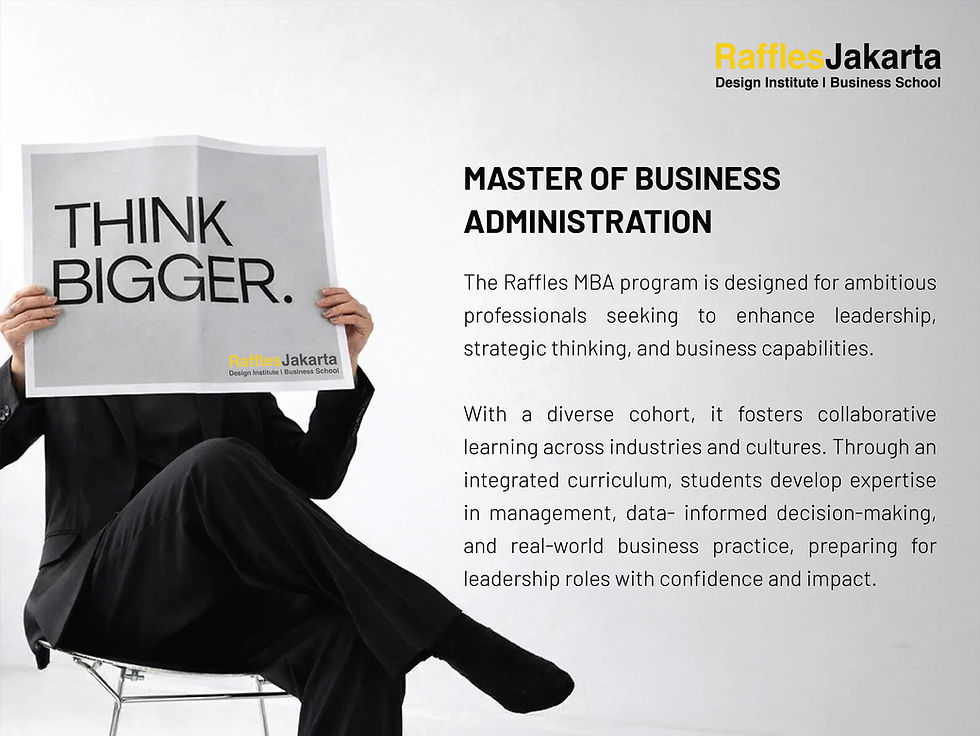
Raffles MBA Jakarta
The Raffles MBA Jakarta is offered by Raffles Jakarta at our campus in Lippo Thamrin, Central Jakarta. It's designed for working professionals who want to move into leadership without leaving the city:
Mentorship from international academics and industry experts
An internationally recognized degree, backed by the Raffles Education network of 16 colleges in 9 countries
Practical, multidisciplinary business learning: finance, marketing, strategy, organizational behavior and leadership, applied to the problems you face at work
A cohort of professionals from different industries, so you learn as much from the people beside you as from the syllabus
Strong industry partnerships and professional connections in Jakarta
Watch how the program works:
Fees, schedules and intake dates change each year, so the quickest way to get exact numbers is to ask our admissions team.
Thinking about an MBA? Chat with the Raffles Jakarta admissions team on WhatsApp or book a free consultation. We'll talk honestly about whether an MBA fits your goals right now.

Intake in January 2027 is now open.
If you're ready to take the step, you don't need to wait another year. Applications for the January 2027 intake at Raffles Jakarta are now open, including the MBA.
Explore the MBA.

FAQ: Is MBA Worth It?
Is MBA worth it if I already have a good job? Yes, if you want to move into a bigger role than your current company will train you for. An MBA is most useful as a bridge to a specific next step, like managing a business unit, changing industry or starting a company. It's less useful if you're happy where you are.
Is MBA worth it in the age of AI, or will AI replace MBA graduates? AI is replacing routine analysis, not decision-making. GMAC's 2026 survey found employers still value MBA graduates and rank AI skills as the most important capability for the next five years. Choose a program that teaches you to use AI in strategy, marketing and operations.
Do most CEOs have an MBA? Not most. About 46% of Fortune 1000 CEOs, CFOs and top tech leaders hold one, according to Fortune's analysis. It's common at the top, but not required.
Am I too old for an MBA at 30, 35 or 40? Not at all. Programs for working professionals are built for this age group. Yale's Executive MBA class of 2025, for example, had an average age of 36. At this stage you bring real experience to class and can apply what you learn straight away.
Is an MBA worth it for engineers? Often. It gives engineers the finance, strategy and people-management skills they need to move from technical lead to business leader.
How much does an MBA cost in Indonesia? It varies widely by school and format. As one published example, SBM ITB Jakarta charged Rp25–40 million per semester for its MBA tracks in 2022/2023. Ask each school for its current total cost, including fees beyond tuition.
Can I do an MBA in Jakarta while working? Yes. Many programs, including the Raffles MBA Jakarta, are designed for working professionals. Message our admissions team for the current schedule and fees.
So, is MBA worth it for me? It is if you can name what you want it to change in your career within the next three years. If you can't yet, talk to people who've done one, and to an admissions advisor, before you decide.
Maria Rosliana
Integrated Digital Marketing Executive
Raffles Indonesia