Three Psychological Safety Strategies Every Leader Can Act On, and Why the Next Generation of Psychologists Will Decide Whether They Work

Few concepts have made their way from academic psychology into the lexicon of the boardroom as quickly as psychological safety. The term was coined in its modern sense by Harvard professor Amy Edmondson, who defines it as “a shared belief held by members of a team that it is safe to take interpersonal risks” (e.g., asking a question, admitting a mistake, or challenging a decision) (Edmondson, 1999). A landmark study of 180 teams by Google, called Project Aristotle, found something that surprised even its researchers: psychological safety was the single greatest predictor of team effectiveness, more than seniority, intelligence, or resourcing (Google re:Work, 2016).
The discussion has shifted from the importance of psychological safety to how leaders can create it in practice. In a recent Forbes article (Kratz, 2026), Julie Kratz distilled the challenge into three strategies that any leader can act on immediately, based on a discussion with Minette Norman and Karolin Helbig, authors of The Psychological Safety Playbook. This article considers those three strategies from an academic perspective, explains why organizations increasingly need psychologists and other professionals trained in the science of human behavior to implement them, and answers a question that prospective students in the Indonesian capital are increasingly asking:
Where can one study psychology at the postgraduate level in Jakarta, and how should an undergraduate education prepare them for it?
Strategy One: Lead with Vulnerability and Humility
The traditional corporate archetype prizes certainty. Leaders are socialized to appear confident, in control, and knowledgeable, and organizational hierarchies often support that performance. But the research record indicates otherwise. Psychological safety starts, according to Kratz (2026) when leaders have the courage to say the words “I do not know” and invite others into the conversation.
When a senior person acknowledges a weakness in public, the message to the team is clear: it’s ok to be human here. And there is sound psychology behind that claim. Employee silence is usually due to something other than a lack of ideas. Rather, it is the result of a rational calculation that speaking out brings with it personal risks, as discussed in Edmondson’s (2018) work on the fearless organization.
Vulnerability at the top alters that calculus. As Norman states in the Forbes article, “the most senior person in the room must be the first to admit failure; otherwise, there is no real permission for anyone else to do so” (Kratz, 2026). In psychological terms, the leader is modeling the very behavior the culture is trying to normalize, a mechanism social learning theory has documented for decades.
Strategy Two: Design Meetings for Active Inclusion
As Kratz (2026) explains, "Meetings are the crucible of workplace culture. They are the battlegrounds where power plays out in real time, where ideas are amplified or muted, and where many employees decide whether they do belong. When not actively managed, meetings are rarely inclusive. The loudest voices prevail while quieter or historically marginalized voices fade to the margins. What Norman and Helbig propose as a remedy is intentional design. Teams can adopt what they call inclusion boosters: structured agreements that govern how a group interacts.
One practical way to do this is to rotate the role of a designated member who monitors the dynamics of each meeting, checks that airtime is distributed fairly and intervenes softly when interruptions happen (Kratz, 2026). The beauty of this mechanism is that it relieves both the leader and the person being interrupted from having to police the conversation, making inclusion an operating procedure rather than just an aspiration.
This approach offers students of psychology a real-life demonstration of research in group dynamics in operation. Production blocking, evaluation apprehension, and social loafing are fundamental concepts in any serious social psychology curriculum; these concepts explain exactly why unstructured meetings fail and why structural remedies are more effective than appeals to altruistic intentions.
Strategy Three: Treat Friction as Fuel for Growth
Of the three strategies, maybe the most counterintuitive relates to disagreement. Kratz (2026) warns that if a team’s meetings are always quiet and consensus comes instantly, then the organization does not have a cohesive team; it has a team that is afraid to speak. Innovation needs friction. But friction needs to be managed, not eliminated. That skill is emotional self-regulation. Leaders with high emotional intelligence can pause between a difficult moment and their response, aware of their own physiological responses before those responses end a difficult but necessary conversation (Kratz, 2026).
People realize that dissent doesn’t result in professional exile and retention improves because people feel valued for independent thinking and not just compliance. The evidence base agrees. Gallup (2024) concludes that engagement, closely correlated with the freedom to voice opinions, remains one of the most powerful levers on productivity and turnover worldwide. The American Psychological Association’s Work in America survey finds that psychological safety is now one of the most heavily weighted workplace conditions for employees (American Psychological Association, 2024). The WHO (2022) has gone further and framed psychologically healthy work environments as a public health priority, not a corporate luxury.
Why These Strategies Require Trained Psychologists
All three strategies seem deceptively simple. All three draw on the core capabilities of psychology: understanding motivation; measuring team climate; designing behavioral interventions; and evaluating whether they worked. McKinsey and Company (2021) found that while most executives are now supportive of psychological safety in principle, few teams experience it, largely because organizations try to change culture without the diagnostic and research skills to do it right. The World Economic Forum (2025) also lists analytical thinking, empathy, and active listening as skills that employers expect will grow the most in importance over the remainder of the decade.
Hence the demand for psychology graduates, especially those who pursue postgraduate study, continues to increase in Indonesia and across the region. Human resources departments, consultancies, hospitals, schools, and research institutions need professionals who can translate concepts such as vulnerability, inclusion, and productive friction into measurable programs. That translation work is precisely what higher education in psychology teaches people to do.
Where Can I Study Psychology at a Master's Level in Jakarta?
For prospective students looking for postgraduate education in psychology in the Indonesian capital, there are several well-established options. The Faculty of Psychology, Universitas Indonesia, in Greater Jakarta, provides programs for both scientific and professional master's and Doctoral degrees and is generally considered the reference institution for the discipline in the country (Universitas Indonesia, 2026).
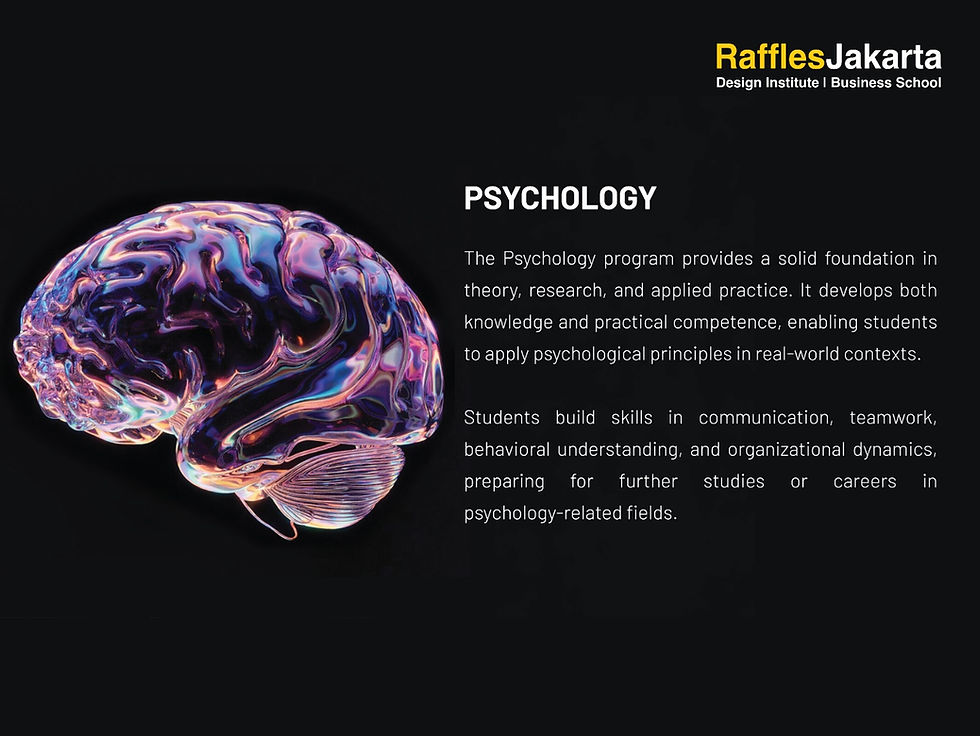
This is where Raffles Jakarta’s psychology program situates itself on purpose.
Raffles Jakarta does not provide a master’s degree in psychology but rather an undergraduate education that equips its graduates to be the exact candidates that admission committees are looking for in master’s and doctoral programs in Jakarta or abroad.
Three features of the program contribute to that goal directly. First, research is framed as a craft rather than a requirement: students learn how to design studies, collect data, and interpret results using the statistical and psychological testing software that postgraduate programs assume incoming students already know (Raffles Jakarta, 2026).
Second, all instruction is in English so that graduates meet the English language requirements of selective master’s and PhD programs, whether at Universitas Indonesia, in Singapore, in Australia, or in Europe, and do not need the remedial preparation that many of their peers require. Third, the program incorporates ethical reasoning, communication, and applied problem-solving across the whole curriculum so that students graduate with both the academic record and the professional portfolio, internships, industry projects, and networking exposure that distinguish the successful postgraduate applicant (Raffles Jakarta, 2026).
The location is in Central Jakarta on MH Thamrin and is part of the Raffles Education network across the Asia-Pacific region. From the first term, the program provides students with an international frame of reference. In short, a student ambitious enough to wish for a master’s or eventually a doctorate in psychology must ask where the postgraduate program will be and which undergraduate program will enable them to gain admission to it. Raffles Jakarta is meant to be that answer.
Conclusion
Psychological safety has evolved from an academic construct to a leadership imperative. Kratz (2026) lists three strategies that are actionable precisely because they are rooted in decades of psychological science, from Edmondson’s team learning research to Google’s Project Aristotle: vulnerability, designing meetings for inclusion, and viewing friction as fuel. But strategies do not implement themselves. “We will need a generation of professionals who are fluent in that science, and those professionals will need rigorous education at every level.” The undergraduate psychology program at Raffles Jakarta is designed to be that launching pad for students in Jakarta who want to go all the way to a master’s degree and beyond on that track—the place where the research skills, the English fluency, and the professional portfolio that postgraduate admission demands are built from day one.
Arman Pour Eisa
Marketing Manager
References
American Psychological Association. (2024). Work in America survey. https://www.apa.org/pubs/reports/work-in-america
Edmondson, A. C. (1999). Psychological safety and learning behavior in work teams. Administrative Science Quarterly, 44(2). https://doi.org/10.2307/2666999
Edmondson, A. C. (2018). The fearless organization: Creating psychological safety in the workplace for learning, innovation, and growth. Wiley. https://www.wiley.com/en-us/The+Fearless+Organization-p-9781119477242
Gallup. (2024). State of the global workplace report. https://www.gallup.com/workplace/349484/state-of-the-global-workplace.aspx
Google re:Work. (2016). Guide: Understand team effectiveness. https://rework.withgoogle.com/en/guides/understanding-team-effectiveness
Harvard Business Review. (2023). What is psychological safety? https://hbr.org/2023/02/what-is-psychological-safety
Kratz, J. (2026, July 19). 3 psychological safety strategies every leader can take action on. Forbes. https://www.forbes.com/sites/juliekratz/2026/07/19/3-psychological-safety-strategies-every-leader-can-take-action-on/
McKinsey & Company. (2021). Psychological safety and the critical role of leadership development. https://www.mckinsey.com/capabilities/people-and-organizational-performance/our-insights/psychological-safety-and-the-critical-role-of-leadership-development
Raffles Jakarta. (2026). Psychology program. https://www.raffles-indonesia.com/psy
Universitas Indonesia. (2026). Faculty of Psychology. https://psikologi.ui.ac.id/
World Economic Forum. (2025). The future of jobs report 2025. https://www.weforum.org/publications/the-future-of-jobs-report-2025/
World Health Organization. (2022). Guidelines on mental health at work. https://www.who.int/publications/i/item/9789240053052