


Should You Study Abroad or Stay Home?

For many Indonesian families, the conversation about university eventually leads to the same point. Should I spend the next few years in Melbourne, Singapore, London, or Milan, or here at home? Both paths are appealing, have real costs, and are frequently described in extremes. Going overseas is portrayed as the sole path to a global career. Staying at home is presented as the safest and most limited option. The truth lies somewhere more interesting.
The question does not concern studying abroad or in your home country. It is what your education provides you with: the people who teach you, the standards you are held to, the network you form, and the opportunities that arise. This guide takes an honest look at both options, as well as a third that many families overlook.
What students really want from going overseas
When students say they want to leave the country for university, they rarely mean to change their postcode. When you ask them why, their responses usually fall into a few distinct categories. They want international teaching from lecturers who have experience in serious industries on a global scale. They seek an international qualification that will be recognized wherever their career takes them. They want classmates from various cultures and a perspective that extends beyond their own city. And they desire independence, the experience of maturing and standing on their own. These are great goals. The important question is which ones truly require a plane ticket and which can be accomplished in other ways.
The real costs of leaving
Studying abroad can be an amazing experience, but it's important to understand what's involved.
Money. Tuition is only part of the picture. Rent, food, transport, insurance, visas, and flights home add up quickly, and living costs in major international cities are often several times higher than in Jakarta. For many families, the total cost of an overseas degree is the single largest financial decision they will make.
Distance. Being far from family at eighteen suits some students and is genuinely hard for others. Homesickness, isolation, and the pressure of managing everything alone can affect well-being and grades, especially in the first year.
Disconnection from home. Students who spend their study years overseas often return without a professional network in Indonesia. If they plan to build a career here, they can find themselves starting from zero, while classmates who stayed already know the industry.
Timing. Applications, visas, and admission cycles for overseas universities can take a long time to arrange, and missing a deadline can mean waiting a full year.
None of these costs make going overseas the wrong choice. They simply mean it should be a deliberate choice, not an automatic one.
The real limits of staying close to home
Staying in Indonesia has obvious benefits: lower costs, family support, and a growing network where you intend to work. However, there are risks if the school is not carefully chosen. Some courses are taught primarily through textbooks by lecturers who have never worked in the industry they teach. Some students graduate with a certificate but no portfolio, industry contacts, or exposure to global standards. When graduates compete for good jobs, this gap becomes especially apparent in the creative and business fields. So the honest answer is that staying at home is only a good idea if the education you receive at home is truly international in quality.
A third option: international education without leaving yet
Many families are unaware that this option exists. Rather than choosing between "overseas" and "local," students can pursue an international education in their own city that includes connections to the rest of the world. Students at Raffles Jakarta study on Jalan M.H. Thamrin, but they are taught by International Creative Practitioners, who are designers, strategists, and business leaders affiliated with Raffles Milano, Raffles University, and the Raffles network.
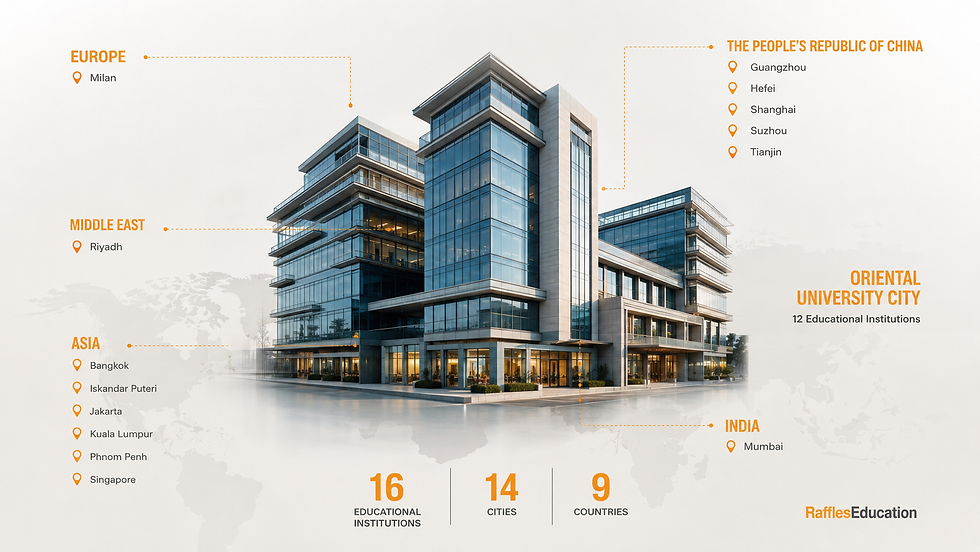
The teaching, studio critiques, and standards that students are held to are all provided by international working professionals. The Jakarta campus is part of a network of 16 institutions spread across nine countries, including Singapore, Kuala Lumpur, Bangkok, Mumbai, Shanghai, and Milan, as detailed on the Our Worldwide Campuses page. An inter-campus transfer pathway enables students to continue some of their studies elsewhere in the network.
For many families, this changes the entire question. A student can start at home, gain confidence and skills with family nearby, and then transition to an international campus later.
When it makes sense to study abroad
For some students, going overseas right away is unquestionably the best option. If a student is emotionally ready, the family can afford it, and the student intends to build a career in another country, an early move may make sense. The same is true when a highly specific program or specialization is only available in one location. Even so, it is worth considering whether the initial stage of research could be conducted closer to home. Many students discover that a year or two of strong international education in their home city, followed by time on another campus, provides them with the best of both worlds: a solid foundation, a home network, and international experience when they are ready to take advantage of it.
What to look for, wherever you study
Whichever path you choose, the same questions separate a strong education from a weak one.
Who teaches you? Look for lecturers with real industry experience, not only academic titles.
How early do you meet the industry? At Raffles Jakarta, Raffles Career Development works through the Centre of Professional Development to bring industry projects, attachments, and career guidance into student life well before graduation.
How fast can you progress? Raffles runs fast-tracked programs with four intakes a year, in January, April, July, and October, so students do not lose time waiting for a single annual start date.
Where do graduates end up? The Alumni Success Story page shows Raffles Jakarta graduates who have gone on to international recognition, including awards at the Mittelmoda Fashion Award in Milan and the ASPAC package design competition, as well as leadership roles at major companies and businesses of their own. Their careers went global, and many of them began right here.
What will it cost, and is support available? Compare total costs honestly, including living expenses, and ask about scholarships. Raffles Jakarta offers scholarships of up to 100 percent.
Making the decision as a family
The best decisions about university are made collaboratively, with honesty on both sides. Students should be clear about their expectations from the experience. Parents should be clear about what is financially and emotionally achievable. Both should look beyond reputation to see what each option actually delivers. A useful exercise is to write down the three things that are most important to the student, such as international teaching, career connections, independence, or cost, and then rank each option against them.
Often, once the goals are written down, the solution becomes obvious. To compare programs and locations, visit the Find Your Path page or schedule a one-on-one consultation. Options include Fashion Design, Interior Design, Business Administration, Artificial Intelligence, and Psychology.
Intake January 2027 is now open.
If an international education close to home sounds like a good fit, you can start sooner than you think. Raffles Jakarta is accepting applications for January 2027 intake programs in fashion, design, business, technology, AI, and psychology.
Here is how to take the next step:
Explore the programs.
Check your scholarship options.
Learn how to apply.
Talk to our team
Book a consultation or message us on WhatsApp.
A global career does not always start with a departure. Sometimes it starts in your own city this January.
Frequently Asked Questions
Is an overseas degree always better than studying in Indonesia? Not necessarily. What matters most is the quality of instruction, industry exposure, and network that a program offers. International education in Indonesia can provide many of the same benefits at a lower overall cost.
Who teaches at Raffles Jakarta? Programs are taught by international creative and business practitioners, including lecturers from Raffles Milano, Raffles University, and the Raffles Education network.
Can I continue my studies on another Raffles campus? Raffles Education operates 16 institutions in nine countries, and an intercampus transfer pathway allows students to complete some of their studies within the network.
Is studying in Jakarta cheaper than going overseas? In most cases, the answer is yes. Living at home or in Jakarta eliminates many of the rent, travel, and visa expenses associated with an overseas degree, and scholarships of up to 100% are available.
Will I still have international classmates and experiences? Raffles Jakarta is part of a global network, and students learn alongside a diverse group of lecturers, practitioners, and partner campuses.
When can I begin? Raffles Jakarta has four intakes per year: January, April, July, and October. The January 2027 intake is now accepting applications.
Head of Marketing


