


The Power of a Global Education Network: How Raffles Education Connects Students Across Continents

This network provides opportunities for students who want an education that goes beyond the walls of a single campus, with lasting benefits that continue long after graduation and provide ongoing support. Higher education today transcends the physical boundaries of a single campus.
Employers are increasingly looking for graduates who can combine technical expertise with cultural awareness, adaptability, and the ability to collaborate in international settings.
This trend has led to students focusing more on institutions that provide opportunities to interact with diverse perspectives, international businesses, and multicultural societies throughout their academic careers.
A strong global education network is one of the defining characteristics of an internationally focused institution. These institutions are building interconnected learning environments that enable students, educators, researchers, and industry professionals to exchange ideas across borders, rather than being isolated campuses. These networks enhance the academic experience and prepare graduates to excel in an increasingly global workplace.
Since opening its first campus in Singapore in 1990, Raffles Education has grown to become one of the leading private education groups in the Asia-Pacific region.
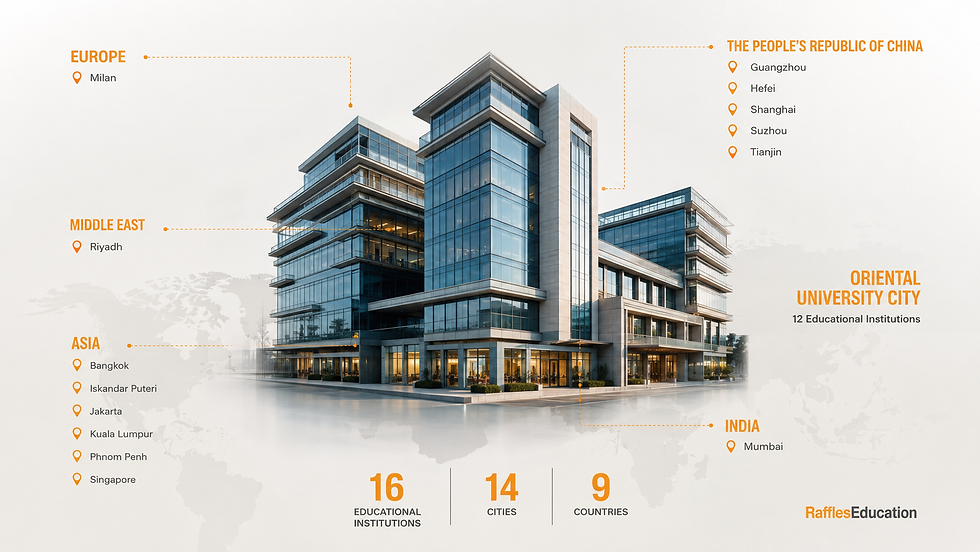
Today, its network of institutions spans several countries, offering students internationally recognized programs, cross-cultural learning experiences, and valuable connections that last long after graduation.
What Is a Global Education Network?
A global education network isn’t just a collection of campuses in different countries. It is an integrated learning environment where institutions collaborate through common academic standards, international partnerships, industry partnerships, and opportunities to connect with students across geographic borders.
In contrast to traditional institutions, which tend to operate in isolation, a global education network allows campuses to share knowledge, expertise, and educational resources.
Students benefit from exposure to different cultural perspectives, professional practices, and academic approaches all while belonging to one educational community.
In an increasingly globalized world, the value of being part of a globally connected institution is ever more important.
International learning experiences often expand students’ perspectives and enhance their intercultural competencies, both of which contribute to long-term professional success.
From a Single Campus to an International Education Network
Raffles Education began with a vision of delivering industry-relevant education that combines academic excellence with practical experience. The institution began at its first campus in Singapore, then gradually expanded across Asia and beyond, establishing campuses in major hubs of education and economics.
Today, Raffles Education has 16 institutions in nine countries and is one of the region’s most established international private education networks.
Every campus is a reflection of the culture, industries, and creative environment of the place where it is located, but all institutions have a common educational philosophy highlighting innovation, creativity, entrepreneurship, and industry collaboration. It achieves this goal by educating students to be internationally connected and locally relevant. Rather than working in isolation, the campuses form part of a collaborative ecosystem where the sharing of ideas, expertise, and educational opportunities is constantly evolving through international cooperation.
Why Global Networks Matter in Modern Higher Education
The requirements for graduates have changed dramatically in the past few decades. Organizations increasingly operate in multiple countries, international collaboration is the norm and digital technologies enable professionals to work with colleagues anywhere in the world. Thus, employers are looking for graduates who can adapt to other cultural settings, communicate well with diverse teams and view challenges from different angles.
Students naturally acquire these skills through study in a global educational network. Students come into contact with classmates from all over the world, exchange ideas with people from different educational systems, and participate in educational experiences with an international scope.
These interactions lead to better communication skills, more cultural awareness, and improved critical thinking, all attributes that are now as important as technical skills in many industries.
International Learning Beyond Geography
International education does not mean just studying abroad. It involves the continued sharing of ideas, experiences, and perspectives from people from different parts of the world. Students in a global education network have the chance to collaborate on projects, participate in international workshops, gain insights from faculty with global industry experience and form connections with peers from various cultural backgrounds.
Experiences like these promote curiosity, expand our intellectual horizons, and develop our ability to tackle complex problems from multiple perspectives. Such interactions for many students become the most valuable parts of their educational journey, promoting academic growth and personal development.
Industry Connections Across Multiple Markets
One of the advantages of an international education group is the opportunity to create strong linkages with industries in different countries and economic sectors.
Each Raffles campus develops partnerships that are pertinent to the local market needs and, at the same time, add to the overall institutional network.
Such collaborations open up avenues for guest lectures, internships, industry projects, competitions, exhibitions, and professional engagement with seasoned practitioners.
Students are immersed in industry practices in several markets and gain a broader understanding of how businesses, creative industries, and organizations operate in different cultural and economic contexts. This wider perspective helps graduates develop into more adaptable professionals who can work more effectively in increasingly international workplaces.
Learning Within Diverse Cultural Environments
One of the greatest advantages of studying within an international institution is the opportunity to learn alongside people from different cultures, languages, and educational traditions.
Daily interactions with classmates from diverse backgrounds encourage students to develop empathy, open-mindedness, and effective intercultural communication skills. These experiences often challenge assumptions while introducing new ways of approaching familiar problems.
Research has shown time and again that multicultural learning environments make students more creative and better problem solvers. This happens because they encounter a wider variety of perspectives and approaches to issues.
Students don’t just read about globalization in books; they live it, working and learning together.
Preparing Graduates for International Careers
Career paths are more international. This is what multinational corporations, international organizations, entrepreneurial ventures, and creative industries need. We need people who can work across cultures and who can adapt to changing global environments.
Students can acquire these important skills before entering the workforce by having educational experiences in a global education network. Graduates develop transferable skills, in addition to discipline-specific knowledge, such as cross-cultural communication, collaboration, adaptability, critical thinking, and global awareness.
These skills provide graduates the confidence to work in different professional environments and to adapt to the changing needs of the industry. Often, such qualities set graduates apart for employers, making them ready not just for today’s workforce but also for tomorrow’s more interconnected workplace.
The Continuing Evolution of Global Education
The future of higher education is becoming more international. Technological advances, digital collaboration, interdisciplinary research, and global industry partnerships are continuously changing the way students learn and the way institutions provide education.
Universities and higher education institutions no longer rely solely on the quality of their academic programs for evaluation. Students also examine opportunities for international collaboration, multicultural learning experiences, industry engagement, and access to global professional networks.
With such expectations constantly changing, institutions with well-established international ties will be increasingly important in preparing graduates for a fast-changing global society.
The Raffles Global Advantage
Global Network
Since opening its first campus in Singapore in 1990, Raffles Education has grown into one of Asia-Pacific's leading education groups, with 16 institutions across nine countries. Our worldwide campuses offer internationally recognized programs that prepare students for global careers.
Industry Excellence
Students at Raffles Education benefit from industry-focused learning, experienced faculty, modern facilities, and practical experiences. This approach develops knowledge, technical expertise, and professional confidence, preparing graduates to excel in competitive industries and evolving global workplaces with lasting success.
Global Mobility
Our flexible inter-campus transfer pathway allows students to study across the Raffles Education worldwide network, experience different cultures, and build an international academic journey while gaining broader perspectives, lifelong friendships, and valuable opportunities for future personal and professional growth.
Worldwide Opportunities
Studying within the Raffles Education global network connects students with diverse learning environments, international classmates, industry collaborations, and cross-cultural experiences that broaden perspectives, strengthen professional networks, and prepare graduates for opportunities around the world.
Marketing Manager
