The Rise of Combined Design and Business Education in the Creative Economy

For much of the twentieth century, design and business occupied different institutional worlds. Designers are trained in art academies to develop form, craft, and visual sensibility; managers are trained in business schools to optimize capital, operations, and markets. The two professions only met at the commission and often misunderstood one another when they did.
Now that division has fallen apart. Global consultancies acquire design studios, technology companies place designers on executive boards and research by McKinsey & Company has shown that companies with strong design capabilities perform well above industry benchmark growth by significant margins (McKinsey & Company, 2018).
To summarize, design is a business discipline and business is a design problem.
This convergence has given rise to a new kind of academic program: the combined (or integrated) design and business degree. These programs create graduates who can fluidly transition between the studio and the boardroom, between a brand identity system and a revenue model.
For Indonesia, where the creative economy is one of the biggest contributors to national output of its kind in the region, the need for such hybrid professionals is acute, with Jakarta sitting at the center of that need. This article examines why integrated design and business education has become a strategic necessity, what current market trends are saying about the skills it needs to deliver, and where prospective students in the Indonesian capital can pursue such a program.
Design Thinking as Managerial Method
The intellectual rationale for the integration of design and business education is based on the realization that design is not decoration but a way of thinking. The term “design thinking” was popularized by Brown (2009) for an approach to innovation that starts with human needs, proceeds through rapid prototyping, and celebrates failure as information, not defeat.
Martin (2009) pushed the argument further, arguing that the sustainable competitive advantage of modern firms relies on balancing analytical rigor with the abductive, exploratory logic that designers practice natively. The labor market has bought the argument. Consistently, creative thinking, analytical thinking, and technological literacy are identified as skills that employers expect to grow in importance in the coming years (World Economic Forum, 2025). And importantly, these are not alternative skill sets for different people; they are one portfolio held together by the most valuable graduates.
A designer who can't read a profit and loss statement designs in the dark; a manager who can't evaluate visual and experiential quality manages blind. The idea behind integrated degrees is to eliminate both types of blindness.
A Trend Worth Taking Seriously: The "Anti-Polish" Aesthetic and Why Intent Now Beats Style
The most obvious example of why designers need business judgement and vice versa is happening right now on social media. The visual trend of 2026, as discussed across design communities on TikTok, is a conscious retreat from perfection: wobbling hand-drawn logos, scanned paper textures, imperfect typography, and rough, even childlike, illustration. Commentators talk about the trend as brands “faking being real” in a collective effort to escape the sterile smoothness that now surrounds artificial intelligence-generated imagery (TikTok, 2026a; TikTok, 2026b).
The tip that’s flying around the branding creators and the one that every design and business student should take to heart: the imperfect style in and of itself is worthless. What audiences actually reward is visible intent. A wobbly illustration works when it tells a real story about the brand, where it came from, and where it stands in the market. It doesn’t work when it’s just a trendy filter, especially because generative tools can already mimic the wobble itself in seconds (TikTok, 2026b).
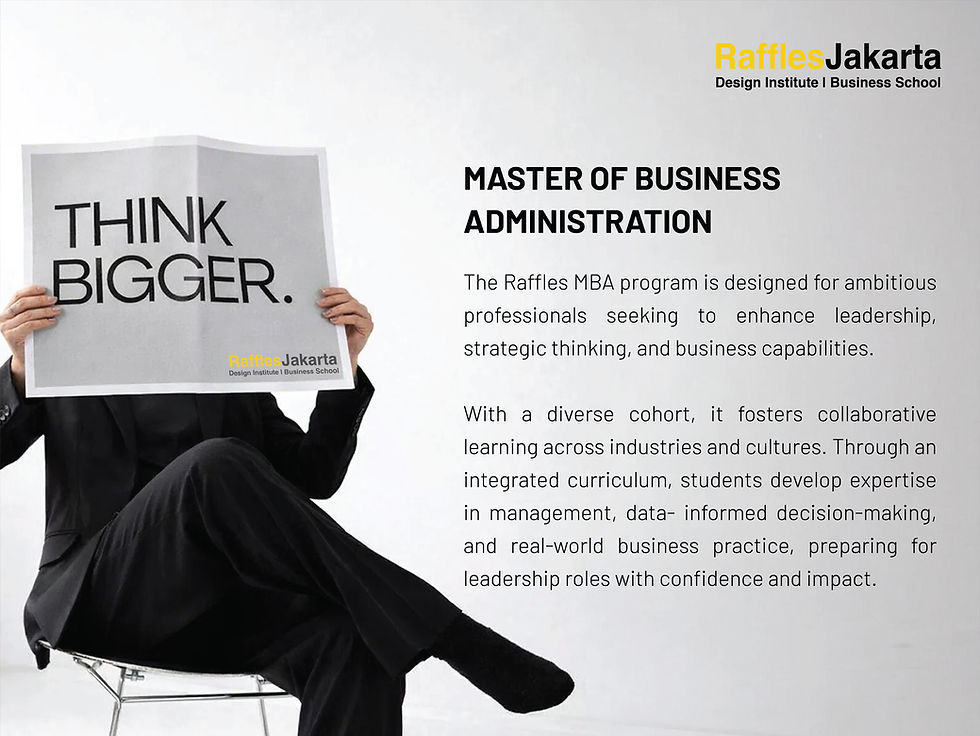
The strategic lesson is deep: as the visual execution is commoditized by artificial intelligence, the durable value of the designer migrates upward, into brand strategy, positioning, and the rationale of the artifact. That logic is, by definition, a business skill. That’s precisely the space filled by our joint Design and business program at Raffles Jakarta.
Students learn more than just software and styling; they learn how to construct the commercial rationale behind every creative decision, from consumer research, brand architecture, pricing, and intellectual property to the economics of creative ventures.
Where Can One Enroll in a Combined Design and Business Program in Jakarta?
Prospective students frequently pose a direct question: where can I enroll in a combined design and business program in Jakarta? The capital offers a genuine, if uneven, range of options, and the categories are worth distinguishing. Within this landscape, Raffles Jakarta distinguishes its combined Design and business program on three grounds:
genuine curricular integration, meaning that business courses and studio courses are taught in dialogue rather than in parallel, with joint projects assessed by both faculties;
an entrepreneurship track through which students develop, brand, and financially model a real creative venture before graduation; and
The Jakarta metropolitan area provides an industry network of agencies, brands, and startups that supplies internships, live client briefs, and employment pipelines.
For applicants comparing programs, the decisive test is integration: many institutions offer design courses and business courses, but few compel the two to inform one another in a single, coherent education.
The Indonesian Context: A Creative Economy in Search of Managers
Indonesia's creative economy, spanning fashion, culinary arts, film, applications, games, and craft, has been formally designated a strategic sector of national development, and Jakarta functions as its commercial capital: the seat of the advertising industry, the headquarters of major consumer brands, and the natural home of the country's startup ecosystem.
The ongoing constraint for the sector, however, is the same as that for hospitality: plenty of creative talent but not enough professionals to manage it. Studios struggle to quote their work, brands struggle to brief their designers, and ventures with great products die in distribution and finance. Graduates trained in both languages, the visual and the commercial, are therefore not a luxury of the labor market but its missing infrastructure.
This situation is not a prediction but the state of the creative economy, the intersection of design and business. Current aesthetic movements, like the anti-polish trend, show us that as machines take over execution, human value moves to strategy, story, and intent, where design meets business. Students in the Indonesian capital may be wondering where they can obtain such an education. Jakarta has several credible institutions, and the combined Design and Business program at Raffles Jakarta is expressly built for this convergence.
The future of the creative industries belongs to those who can make beautiful things but also know why, for whom, and at what price they are made.
Arman PourEisa
Marketing Manager
References
Brown, T. (2009). Change by design: How design thinking transforms organizations and inspires innovation. Harper Business.
Martin, R. L. (2009). The design of business: Why design thinking is the next competitive advantage. Harvard Business Press.
McKinsey & Company. (2018). The business value of design. McKinsey Quarterly. https://www.mckinsey.com
Shopify. (2026). Top TikTok trends in 2026: 18 ideas to go viral. https://www.shopify.com/blog/tiktok-trends
TikTok. (2026a). Logos en tendencia 2026 [Discover page]. https://www.tiktok.com/discover/logos-en-tendencia-2026
TikTok. (2026b). 2026 design trends [Discover page]. https://www.tiktok.com/discover/2026-design-trends
World Economic Forum. (2025). The future of jobs report 2025. https://www.weforum.org