


What Management Actually Asks of You

After you get promoted, there is a particular silence. The announcement is made, the congratulations are received and then the new manager sits down at the same desk with a new title and realizes that no one has told them what the job is. They know more or less what their forerunner did. They sort of know what their manager’s after. What they don’t know, what almost nobody tells them, is that the work they were promoted for is different from the work they are now being paid to do. This is not a failure of individual preparedness. It’s a structural thing about how people are promoted in organizations.
The analytics manager is the best analyst. The top salesperson is assigned the regional territory. He is the person who is responsible for the team that tackles challenges. He is the engineer who solved the hardest problem. In each case, the promotion is a reward for individual technical excellence and then immediately asks for something else entirely: the ability to deliver results through other people, most of whom won’t do it the way the new manager would have done it.
For more than half a century, the scholarship of management has documented this gap, and it is worth knowing what that research actually found, because the findings are considerably less flattering and considerably more useful than the language of leadership development usually implies.
The job is not what the job description says
The seminal work in this area is Henry Mintzberg's systematic observation of chief executives, later summarized for a wider audience in the Harvard Business Review under a title that says most of what needs saying, “The Manager's Job: Folklore and Fact” (Mintzberg, 1990). In folklore, managers were reflective, systematic planners. In fact, when researchers shadowed managers at work and observed their behavior, it turned out to be almost the opposite. Their work was brief, varied, and broken up.
The median duration of activities was less than 9 minutes. They were more the nerve centers of an information network than the tidy planners of textbook theory, preferring to talk to people rather than read reports, gathering soft intelligence through relationships and acting on it quickly. Mintzberg described ten roles in three categories of what he observed: interpersonal roles such as figurehead, leader, and liaison; informational roles such as monitor, disseminator, and spokesman; and decisional roles such as entrepreneur, disturbance handler, resource allocator, and negotiator (Mintzberg, 1973). If you’re a newly promoted specialist, what’s striking about that list is how little of it looks like the work that got you promoted.
None of the ten roles are to 'deliver great technical output.' Fred Luthans took the finding into even more uncomfortable territory. In a large observational study of managers in actual organizations, his team found a difference between successful managers—in terms of how quickly they were promoted—and effective managers—in terms of unit performance and subordinate satisfaction.
The two groups were occupying their time quite differently. Effective managers network a lot harder than the average manager. They socialize, they politick, and they engage outsiders. The effective managers concentrated on human resource management and routine communications. The overlap between the two groups was minimal (Luthans, 1988). It doesn’t tell managers what to do, but it does tell them that the organization may be measuring something other than what it claims to value. That is knowledge of management itself.
Management and leadership are different problems
Consultancy language has blurred the line to the point of uselessness but John Kotter’s version is analytically precise and worth recovering. To him, management means managing complexity. Planning and budgeting, organizing and staffing, controlling and problem-solving create order and consistency. Leadership is managing change. It has a direction, it aligns people, and it motivates and inspires.
Kotter wasn't saying one was better. Both capacities are required in different proportions at different times and most organizations are overmanaged and underled (Kotter, 2001). In practice, this means staffing, andngle manager has to behave differently with each and each is learned in a different way. Spreadsheet for teaching planning and budgeting in the classroom. Alignment just isn’t possible, not like that.
Alignment is a communication problem and a credibility problem. Credibility is built, not bought. Robert Katz provided an earlier but still useful framework for thinking about how the mix changes with seniority. He identified three types of skills: technical, human, and conceptual. Technical skill dominates the operating level. Human skill—working well as a group member and developing cooperative effort—is important at all levels.
At the top, conceptual skill becomes critical; this skill involves the ability to see the enterprise as a whole and understand how the various functions are interdependent (Katz, 1974). It is a slow rebalancing of a portfolio; in Katz’s terms, the technical share declines, the conceptual share increases, and the human share is never reduced.
What the first year of authority actually feels like
Of the accounts of the transition, Linda Hill’s longitudinal study of new managers is one of the most honest, primarily because she studied people as they were experiencing it, not asking them to recall it later. Her subjects always came with a wrong model of the role. They sought authority and found dependence.
They thought they'd be the ones with answers, and instead, they found themselves managing an agenda they didn't control. They assumed their formal position would ensure compliance and discovered that influence had to be earned from subordinates, peers, and superiors alike, none of whom had to be convinced (Hill, 2007).
Hill’s conclusion that new managers must learn first to lead themselves is no motivational flourish. It is about something specific: the transition requires a revision of professional identity and identity does not revise itself according to a schedule. The manager who continues to find satisfaction in personally solving the problem will continue to take the problem back from the person who should be solving it and will read his own exhaustion as evidence of commitment rather than as evidence of an unfinished transition.
The team is the unit of performance
For a good part of the twentieth century, scholars focused the study of management on the individual manager. More recent work has shifted the unit of analysis to the team and has had significant results. Amy Edmondson’s research introduced psychological safety to the organizational literature: the shared belief that a team is safe for interpersonal risk-taking, that a member can ask a question, admit a mistake, or challenge a decision without fear of humiliation or punishment. Her early research indicated that psychological safety was related to learning behavior and that learning behavior predicted team performance (Edmondson, 1999).
The counterintuitive detail, and the one most useful to a working manager, was that better teams in the data seemed to make more mistakes. They didn't. They reported more because it was safe to do so. Google’s internal research program arrived at a convergent conclusion through a different route. The project examined scores of teams across the company and discovered that it was less important who was on a team than how the team worked together, and that psychological safety emerged as the strongest factor separating effective teams from ineffective ones (Google re:Work, 2016). It is a new perspective for a manager to take on the job.
The job is not to herd the best people available and supervise them. It is to create the conditions under which a group of competent, ordinary people will tell each other the truth. Gallup’s work adds the cost to the organization of getting it wrong. Its research has consistently shown that the manager accounts for a substantial proportion of the variance in team engagement, putting the rtogether and for one of the most expensive problems in modern organizations squarely on the shoulders of people who, in most cases, were promoted for something else (Gallup, 2015).
What skills do you actually need to become a manager?
Reading across this literature, the demands separate into four categories, and they are worth stating plainly because the vocabulary of leadership development tends to obscure them.
Financial and quantitative literacy. Not the ability to prepare accounts, which is a specialist function, but the ability to read them. A manager who cannot interrogate a budget, understand how their unit's costs behave, or explain the financial consequences of a proposal will be managed by whoever can. Katz's technical skill does not disappear at the senior level; it shifts from the discipline the manager came from to the language the organization uses for decision-making.
Judgment about people. Selection, delegation, performance conversations, the handling of underperformance, and the construction of the conditions Edmondson describes. This skill is the least teachable in the abstract and the most improvable through structured practice and feedback.
Strategic reasoning. The capacity to hold a position and defend it, to understand where an organization competes and why, and to distinguish between a decision that is difficult and a merely uncomfortable decision. Kotter's direction setting and Katz's conceptual skill sit here.
Political and relational competence. Luthans's uncomfortable finding is that networking correlates with advancement. A more generous reading is that organizations are coalitions, that resources are allocated through persuasion, and that a manager who refuses to participate in that process is abdicating more than being principled.
The World Economic Forum’s regular survey of employers reaches a broadly similar conclusion on the demand side. The half life of purely technical skills is shortening (World Economic Forum, 2025). Skills reported by employers as increasing in importance include analytical thinking, resilience and flexibility, leadership and social influence, and creative thinking. The pattern is not that technical knowledge is no longer important. It is that the capacities to deploy technical knowledge through other people appreciate over a career while specific technical content depreciates.
The part organisations are getting wrong
There’s a supply-side problem here as well, and it’s worth acknowledging because it explains why so many capable managers feel they are failing at something no one has defined. McKinsey, in its analysis, argues that middle managers spend a considerable amount of time on administrative and individual contributor work and not on people management, suggesting that organizations systematically underinvest in the very layer they rely on to translate strategy into execution (McKinsey and Company, 2023). Likewise, Deloitte’s human capital research has found that although organizations state that leadership development is a priority, they still promote technical performance and train after the fact instead of before (Deloitte, 2023). The implication for the individual is an uncomfortable one but clarifying. If the organization is not likely to prepare you for the role before it gives you the role, then preparation becomes something you arrange for yourself.
Where can you study management in Jakarta while working?
This is where the argument becomes practical and this is where the formal postgraduate study earns its place rather than being subsumed into it. An MBA is not a leadership personality transplant and any program that markets itself as one should be met with skepticism. What a serious MBA curriculum does is much more specific: it provides, in a compressed and examinable form, the parts of the managerial job that can really be taught. "Accounting for Decision Making" and financial management promote the quantitative literacy described above. Managerial Economics provides the analysis of the market conditions that guide decision-making.
Organizational behavior deals with the human dimension Katz identified and Edmondson operationalized. Strategic Management develops the conceptual capacity that becomes crucial as responsibility grows. Research Methodology is often considered the least practical part by candidates but it is actually the subject that makes the difference between a manager who builds evidence and one who borrows opinions.
The Master of Business Administration (MBA) at Raffles Jakarta is a one-year course and conducted fully in the English language at Jalan M.H. Thamrin in Central Jakarta.
Raffles has four intakes each year: January, April, July, and October. It is the only program at the school available in two delivery formats, on campus or hybrid, the latter being a blend of online study and scheduled campus sessions.
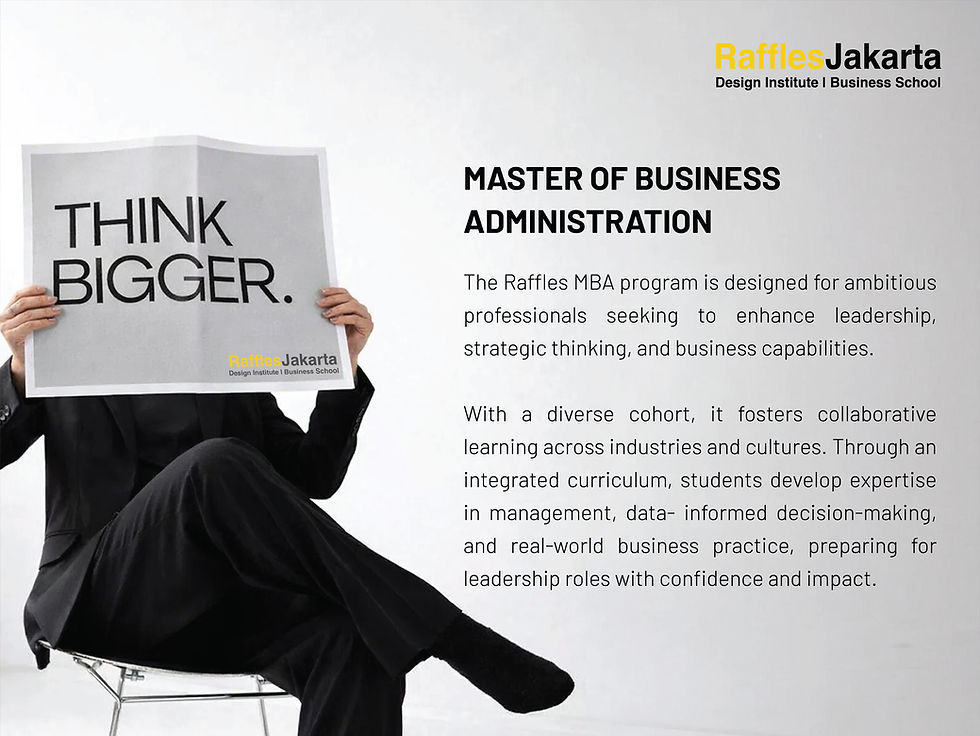
That design decision is directly relevant to the argument of this paper. By definition, the people who most need managerial education are the people who already have managerial responsibility. The central absurdity of executive education has always been the request to step away from work in order to learn how to do it. Another point that the research supports and that prospectuses rarely make explicit is the following: An international program does not just have the incidental feature of a cohort of people from different countries and different industries. That is a device. A manager who defends a position only to colleagues who share their assumptions has not, in any rigorous sense, defended it.
Conclusion
What management wants of you is not more of what you were good at. It invites you to become fluent in a second language, the financial and strategic language in which organizations actually make decisions, while building a tolerance for delivering results that you did not personally deliver. It tells you to build conditions, not results. And it asks you to accept that your authority, no matter what the org chart says, comes from the people you manage, not from the people who promoted you.
That doesn't come with the title. Some of it you only learn by doing it badly first. But a large and identifiable part of it, the quantitative literacy, the strategic reasoning, the evidence discipline, and the structured understanding of how people behave in organizations, is teachable and has been taught for a century.
Managers with the least trouble are sometimes less naturally gifted. Usually, these are the ones who realized early that the job had changed and sought the instructions no one would give them unless they asked.
Arman PourEisa
Marketing Manager
References
Deloitte. (2023). 2023 global human capital trends. https://www2.deloitte.com/us/en/insights/focus/human-capital-trends.html
Edmondson, A. C. (1999). Psychological safety and learning behavior in work teams. Administrative Science Quarterly, 44(2), 350 to 383. https://journals.sagepub.com/doi/10.2307/2666999
Gallup. (2015). State of the American manager: Analytics and advice for leaders. https://www.gallup.com/services/182138/state-american-manager.aspx
Google re:Work. (2016). Guide: Understand team effectiveness. https://rework.withgoogle.com/en/guides/understanding-team-effectiveness
Hill, L. A. (2007). Becoming the boss. Harvard Business Review. https://hbr.org/2007/01/becoming-the-boss
Katz, R. L. (1974). Skills of an effective administrator. Harvard Business Review. https://hbr.org/1974/09/skills-of-an-effective-administrator
Kotter, J. P. (2001). What leaders really do. Harvard Business Review. https://hbr.org/2001/12/what-leaders-really-do
Luthans, F. (1988). Successful vs. effective real managers. Academy of Management Executive, 2(2), 127 to 132. https://journals.aom.org/doi/10.5465/ame.1988.4275524
McKinsey and Company. (2023). Stop wasting your most precious resource: Middle managers. https://www.mckinsey.com/capabilities/people-and-organizational-performance/our-insights/stop-wasting-your-most-precious-resource-middle-managers
Mintzberg, H. (1990). The manager's job: Folklore and fact. Harvard Business Review. https://hbr.org/1990/03/the-managers-job-folklore-and-fact
Raffles Jakarta. (2026a). Master of Business Administration. https://www.raffles-indonesia.com/mba
Raffles Jakarta. (2026b). Think bigger: The Raffles Jakarta MBA 2026. https://www.raffles-indonesia.com/think-bigger-mba-jakarta
Raffles Jakarta. (2026c). Frequently asked questions. https://www.raffles-indonesia.com/faq
World Economic Forum. (2025). The future of jobs report 2025. https://www.weforum.org/publications/the-future-of-jobs-report-2025/

