Why an MBA Is Often a Bridge Between Two Careers

There is a certain type of professional who excels at their job and quietly finishes it.
The engineer who no longer wants to build the product but rather manage the company that produces it.
The doctor is drawn to running the hospital rather than simply treating patients.
The banker considering a move into technology, the marketer who prefers to shape strategy rather than execute campaigns, and the specialist who has mastered a craft and now seeks a broader perspective.
Neither of them is failing. They have simply outgrown the career that has brought them this far and can see a different one, from a distance, that they cannot quite reach.
There is a gap between their current and desired careers, and it is usually not due to ambition or ability.
The new field expects a gap in credentials, a network to which they do not yet belong, a professional language they do not yet speak, and, most stubbornly, an identity. You can't just announce that you're the next big thing and expect everyone to agree.
There must be a way to bridge the gap, some structure that transports a person from one professional life to the next.
For many people, that structure is the MBA. We usually refer to the MBA as an accelerator, a way to move up the existing ladder faster.
That is one of its practical applications. However, its most distinguishing and least understood function is different. For many of those who pursue it, the MBA is not even a rung on an existing ladder. It is a link to another one.
Careers now bend more than they climb
The idea behind that bridge is that careers no longer follow a straight path. The old model, in which a field is entered young and climbed steadily until retirement, has been replaced by working lives that change direction frequently as industries reshape and entire categories of work emerge and disappear.
The world's largest employers now see reskilling and career mobility as defining characteristics of the coming decade of work (World Economic Forum, 2025). In that environment, the ability to switch careers is no longer considered a specialized skill.
This need is now nearly universal. Crossing is truly difficult because experience does not help you make the transition.
The very expertise that made someone successful in their first career may be precisely what the second one does not recognize, leaving accomplished people stuck on the near bank, overqualified for their current position, and undercredentialed for their desired future position.
The hardest part of changing careers is not deciding to leave the old one. It is that the new one does not yet see you as one of its own.
Why an MBA is often a bridge between two careers, not just a rung on one ladder
This is the exact crossing that the MBA is intended to facilitate. Research on graduate management candidates distinguishes between "career enhancers," who use the degree to advance within their current path, and "career switchers," who use it to change direction; the switchers are a significant and defining segment of the population (Graduate Management Admission Council, 2025).
The switcher's signature ambition is what the field refers to as the "triple jump": changing industries, functions, and locations all at once, one of the most difficult moves a professional can make and one that the MBA is specifically designed to support by providing the time and space for a true career reset (Graduate Management Admission Council, 2024).
This phenomenon is why an MBA is often used as a bridge between two careers rather than a faster path to one. People do not spend a year or two and a large sum of money just to do the same job with a better title; many do it to reach a position they could not have obtained by staying put.
The degree's broad rather than narrow structure facilitates this transformation: by teaching the entire field of management rather than just one function, graduates are prepared to work in almost any part of a business, which is precisely what switching requires.
Reinvention means trying on possible selves, and you need somewhere to do it
Understanding why the bridge works requires an understanding of how career change occurs, which is not what most people expect. The intuitive model, "Find out who you want to be, then go be it," proves to be incorrect. According to the most influential research on the subject, career reinvention is a twisted process of trial and error in which people discover who they want to be by experimenting with various "possible selves," rather than introspecting their way to a single true answer (Ibarra, 2003).
You discover a new career by trying it out. That process takes a familiar form: try new activities, form relationships in new networks, and make sense of the transition as it occurs (Ibarra, 2002).
However, all three necessitate something that most people in transition lack: a place to experiment, a setting in which you can practice being your new professional self before fully committing to it.
One of the advantages of the MBA is that it provides a structured environment in which to experiment with a future career at a low risk before fully committing to it.
Business school is, quite literally, an identity workspace
There is a scholarly term for what that space does. According to one influential analysis, business schools function as "identity workspaces," institutions that provide a holding environment for the difficult psychological work of changing who you are professionally, as well as dependable social support, a community of people going through the same transition, and the structure of a genuine rite of passage (Petriglieri & Petriglieri, 2010).
As careers have become more individualistic and companies less reliable for figuring out who you are, the MBA has taken on a larger role.
This phenomenon is the primary reason why the MBA functions as a bridge. The transition between two careers is both practical (acquiring skills and contacts) and psychological (becoming a different type of professional), and it requires a container in which to take place safely. The MBA provides the container: a set time, a supportive cohort, and a recognized threshold to cross, ensuring that the person who emerges is legitimately and visibly new.
An MBA does not just teach you the new career. It gives you a place to become the person who can hold it.
The bridge has an uncomfortable middle, and that is the point
Crossing a bridge requires spending time suspended between two solid foundations, and this middle passage is what most people want to avoid but cannot. During this transition period, you are neither fully an old professional nor fully a new one; the discomfort is palpable. However, discomfort is not a sign of error; rather, it is a natural part of the growth process.
According to the study, we become who we want to be by pushing beyond our current selves, doing unfamiliar and uncomfortable things that teach us who we are becoming through direct experience, and refusing to believe an outdated story about ourselves (Ibarra, 2015).
The MBA's value is that it helps a person navigate the awkward middle rather than leaving them to leap the chasm alone in a single terrifying leap. And it does more than just transport them; it prepares them to land, arrive in their new role, and succeed, which is a unique challenge that requires its own deliberate strategy (Watkins, 2013).
A good bridge not only transports you to the other side, but it is also ready to walk on when you arrive.
What the bridge is actually made of
It is useful to be specific about the load-bearing structure. A career changer typically lacks three distinct characteristics, and the MBA is intended to address all three. The first is capability and language, or the overall management ability to be credible in a field with which you are unfamiliar.
The second is a network, an entirely new set of relationships in the world you are transitioning to, which is why changing your connections is critical to reinvention and the cohort is equally as important as the curriculum. The third type is a credential, which is a recognized, legitimate signal that validates your new identity in the eyes of employers who have not yet met you.
The bridge includes three cables: capability, network, and credential. Any one of them alone makes the crossing insufficient: skills without a network go unnoticed, a network without credibility goes unconverted, and a credential without capability fails when confronted with the actual job.
The MBA is unique in that it combines all three into a single, time-bound structure.
Where the crossing is designed to happen
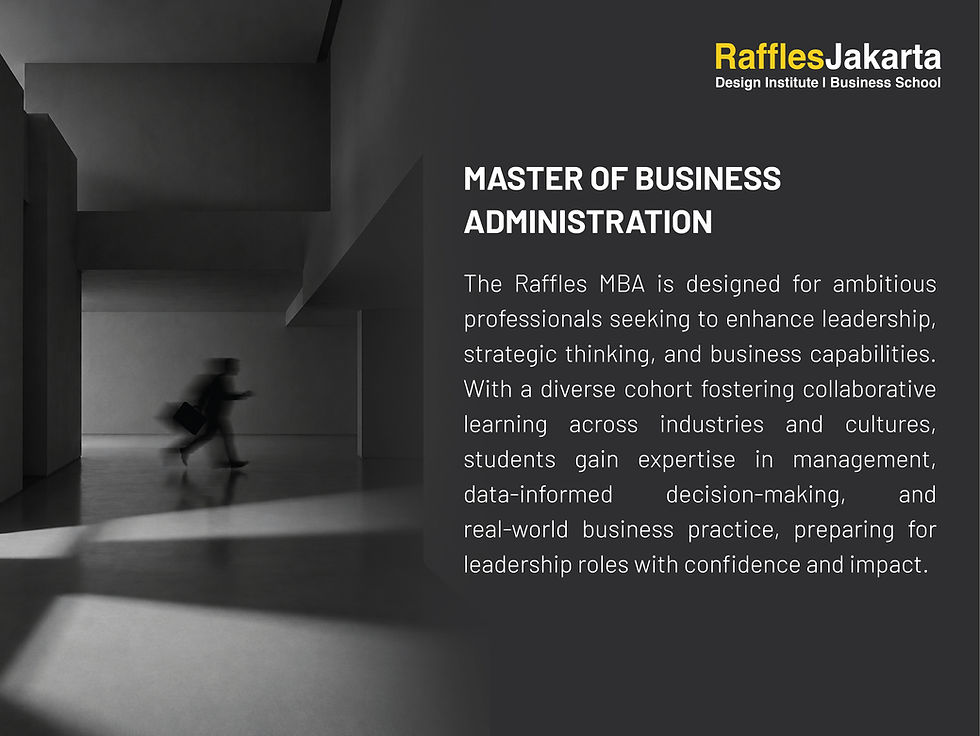
This is what a well-built MBA is for, and it is critical to specify how its design benefits the crossing. The one-year Raffles Jakarta MBA program facilitates a faster transition and return to a redirected career.
Its general management curriculum, which includes strategy, finance, marketing, economics, and organizational behavior, is intended to be broad enough to allow graduates to transition into any function they choose rather than being stuck in the one they came from. Its cohort becomes the new professional network upon which reinvention is built, and as part of Raffles Education's international system, it broadens the switch's geographical scope.
As part of Raffles Education, which was founded in Singapore in 1990 and now operates 16 colleges in 14 cities across nine countries, a degree earned here belongs to an international network rather than a single market.

The far side
The professional standing on the near bank, good at the old job and drawn to a new one, usually does not need any more ambition or talent. They need a bridge, a structure that provides the capability, network, credentials, and space to become someone new, so that the gap between their current career and the one they want becomes a crossing rather than a chasm.
An MBA is most often defined by its purpose rather than any specific skill it teaches.
It is a bridge, not a destination; it is not the end of one career or simply the continuation of another, but rather a structured transition from the professional you have been to the one you are about to become.
Who you become on the other side is the whole point, and choosing to build that bridge rather than stare across the gap is one of the most obvious ways a person can decide to think bigger (Raffles Jakarta, 2026b).
Marketing Manager
THINK BIGGER, READ MORE


References
Graduate Management Admission Council. (2024). How career switchers succeed with an MBA. https://www.gmac.com/resources/learners/business-careers/career-planning/how-career-switchers-succeed-with-mba
Graduate Management Admission Council. (2025). Prospective students survey 2025. https://www.gmac.com/-/media/files/gmac/research/prospective-student-data/2025/2025_pss_final.pdf
Ibarra, H. (2002). How to stay stuck in the wrong career. Harvard Business Review, 80(12), 40–48. https://hbr.org/2002/12/how-to-stay-stuck-in-the-wrong-career
Ibarra, H. (2003). Working identity: Unconventional strategies for reinventing your career. Harvard Business Review Press. https://www.goodreads.com/work/editions/26799-working-identity-unconventional-strategies-for-reinventing-your-career
Ibarra, H. (2015). The authenticity paradox. Harvard Business Review, 93(1–2), 52–59. https://hbr.org/2015/01/the-authenticity-paradox
Petriglieri, G., & Petriglieri, J. L. (2010). Identity workspaces: The case of business schools. Academy of Management Learning & Education, 9(1), 44–60. https://doi.org/10.5465/amle.9.1.zqr44
Watkins, M. D. (2013). The first 90 days: Proven strategies for getting up to speed faster and smarter (Updated & expanded ed.). Harvard Business Review Press. https://hbr.org/books/watkins
World Economic Forum. (2025). The Future of Jobs Report 2025. https://www.weforum.org/publications/the-future-of-jobs-report-2025/
Raffles Jakarta. (2026a). Master of Business Administration. https://www.raffles-indonesia.com/mba
Raffles Jakarta. (2026b). Think bigger: The Raffles Jakarta MBA 2026. https://www.raffles-indonesia.com/think-bigger-mba-jakarta