


How Do Raffles Jakarta Alumni Lead Industry?

Leadership within a creative or commercial sector is usually more than a job designation. It occurs when an individual's efforts transform the perceptions of those in their vicinity regarding feasibility, or when they create something previously nonexistent, or when they ultimately influence the decisions that determine a company's functioning.
This implies that the inquiry regarding the leadership of a school's alumni cannot be resolved merely by enumerating their employers. The response must be derived from an examination of their actions and the potential underlying pattern.
Raffles Jakarta transparently discloses its alumni results, enabling an assessment that is factual rather than conjectural.
How do Raffles Jakarta alumni lead industry?
Raffles Jakarta alumni thrive in the sector via four distinctive pathways. They set groundbreaking standards by attaining success internationally, particularly by winning the Mittelmoda Fashion Award in Milan and the Harper's Bazaar Asia NewGen Fashion Award.
They form organizations, launching fashion labels and businesses, with one graduate recognized in Forbes 30 Under 30 Asia for entrepreneurial achievement.
They occupy decision-making roles within established organizations, in retail management, executive support, and financial operations. They shape culture via works that captivate the public, exemplified by a graduation collection worn by Isyana Sarasvati and featured in Harper's Bazaar Indonesia.
The shared aspect among these is not a singular career path but a communal endeavor: producing work of professional quality at an early age and showcasing it to those who assess it professionally.
Leading by setting the standard
The initial type of leadership remains the least examined and arguably the most impactful. An individual achieves victory, thereby reshaping the aspirations of others present.
Numerous students and alumni from Raffles Jakarta have accomplished feats on an international scale. Angelique Keizia secured the Mittelmoda Fashion Award in Milan, a contest that has historically provided a gateway for nascent designers into the European market (Mittelmoda, 2025).
Christabell Bellini emerged as the sole finalist from Southeast Asia in the 2025 iteration of the award. Geralda Almira Pribadi secured the Harper's Bazaar Asia NewGen Fashion Award and advanced to the Mittelmoda finals in Milan (Raffles Jakarta, 2025).
The domestic record is comparable. Carolin Valentina triumphed at Jakarta Fashion Week 2025, while Caroline Devina secured the position of First Runner Up at Lomba Perancang Mode 2023 during the same event.
Tadeus Gerald Susanto, a student of multimedia design, gained global acclaim for his award-winning artworks showcased in international competitions.

Two aspects merit attention. Numerous accomplishments occurred while the individual was still enrolled as a student rather than after years of professional experience. Their aggregation implies a systematic pipeline instead of a sequence of isolated incidents.
Recently, we honored award-winning students Dollie and Dyllon as they represent Indonesia at the international level during Milano Design Week, presenting their exceptional winning projects.
The mechanism behind that pipeline is not mysterious.
A competition is a specific, challenging goal with a set deadline and an outside standard, closely resembling the best conditions for people to perform at their highest level. When a studio consistently participates in such contests, the overall caliber within the space elevates for all involved.
Leading by building
The second type is entrepreneurial, representing the most evident form of industry leadership as it creates something that was not previously available.
Nicole Lay, a graduate in fashion design, established PRSNL, a modern women's fashion label, transforming an entrepreneurial concept into a functioning enterprise.
In 2019, Forbes 30 Under 30 Asia recognized Sabrina Bensawan for her remarkable entrepreneurial success. William, a graduate in business administration, propels expansion at PT Hexa Samudra Rejeki while co-owning PT Karya Seni Offset and establishing a foundation that operates in both commercial and social domains simultaneously.
Naomi Ivo, pursuing a degree in business administration, operates globally as an esteemed vocalist, entrepreneur, and recording artist, highlighting that in creative sectors, the individual and the business frequently represent a singular asset.

Establishing an enterprise necessitates a specific amalgamation: the proficiency to create the product, the acumen to price and market it, and the resilience to advance without assured results. This combination is unusual because most education systems focus on one of the three areas while neglecting the others.
Programs that integrate creative fields with business administration, fashion marketing and management, and an MBA within a single institution provide students with consistent interaction across all three areas.
Leading inside organisations
The third variant is less apparent externally yet impacts more individuals. It refers to leadership implemented within an established organization, where an individual ultimately makes the decisions.
Graduates in Business Administration have ascended to corporate leadership roles, including one who currently serves as the Head of Retail Operations at Samsung Electronics Indonesia. Rilla Puspita, an MBA alumna, aids executive management and fiscal operations as a Senior Personal Assistant at a premier online trading firm in Indonesia.
These positions hold significance for a particular purpose. Retail and financial operations are the domains where strategy either succeeds or falters, and the individuals in these roles influence an organization's actual conduct rather than its self-perception.
This role is typically attained more swiftly by individuals who possess prior knowledge of business operations, supporting the case for teaching business via live case studies, consultancy projects, and industry placements instead of relying solely on theoretical frameworks.
The employer perspective on this matter is thoroughly recorded.
A study utilizing national survey data from over 76,000 alumni revealed that experiential learning in the workplace significantly enhanced perceived employability as well as foundational, adaptive, and collaborative competencies (Jackson & Dean, 2023).
Leading by shaping what people see
The fourth category pertains to culture. Creative endeavors engage a broader audience and shape preferences, representing a genuine yet subtle form of industry leadership.
Farren Tjiu's graduation collection was donned by Isyana Sarasvati and showcased in Harper's Bazaar Indonesia, transitioning from a student endeavor to a national cultural discourse.
Design endeavors showcased in publications, on artists, in exhibitions, and within retail spaces contribute to the visual lexicon of a nation. Individuals involved in its creation are influencing it, regardless of whether they possess an official designation.
This field is currently of significant importance in Indonesia. In 2025, the creative economy engaged 27.4 million individuals, constituting approximately 18.7 percent of the national labor force, an increase from 26.48 million in the preceding year, contributing Rp1,611.2 trillion to the gross domestic product in 2024, representing around 7.28 percent of the national output, with over half of its workforce being under 40 years old.
The fashion and craft industries have driven export success in the sector (Kemenekraf, 2025).
A burgeoning creative economy particularly welcomes input from individuals at the onset of their careers, as it is still establishing its norms.
Leading by building the next generation
A fifth type of leadership seldom reflected in outcome metrics may be the most enduring. It occurs when individuals who have secured their position assist others in advancing.
Raffles Jakarta organizes alumni engagement activities, featuring sessions that link graduates employed in the industry with students currently in the studio.
The worth of these items is objective rather than emotional. A pupil who receives insights from someone three years older gains knowledge that no syllabus conveys: the authentic experience of the inaugural year in a studio, the significant aspects of the training, the process of securing a first client, and the realistic expectations of a timeline. That data diminishes the frequency of preventable errors within a group, which accumulates throughout an industry over time.
It additionally contributes to ambition. Observing an individual from the same program functioning competently in the field transforms an abstract potential into a tangible reality, and faith based on a witnessed instance is significantly more robust than faith based on mere encouragement (Bandura, 1977).
This case illustrates the manner in which professional communities perpetuate their existence. The institutional frameworks are significant, yet a discipline thrives through the commitment of practitioners who are accountable for future generations.
Graduates engaging in this practice are manifesting leadership within the industry in a tangible manner: they are shaping the future composition of the industry.
What the pattern has in common
Looking across all four modes, the same underlying habits recur.
Work produced to a professional standard early. Because teaching is delivered by an international academic team of practicing professionals holding international certifications and substantial industry experience, students are measured against industry criteria from the beginning rather than academic ones.
Repeated exposure to external judgement. Critique, exhibitions, student showcases, and competitions all involve someone other than the maker assessing the work. In design education, this critique is recognized as a signature pedagogy, the characteristic way a profession forms its members (Shulman, 2005).
Evidence rather than credentials. Every one of these outcomes was based on something produced. Experienced hirers note that claims on a résumé carry little weight compared to visual proof of what a person has actually made (BYU Design Review, 2025), and confidence built on direct experience of mastery is more durable than confidence built on reassurance (Bandura, 1977).
Industry contact during study rather than after. The Centre of Professional Development runs projects, industrial attachments, industry research, and career support alongside study, with the stated aim of assimilating students into the industry long before graduation.
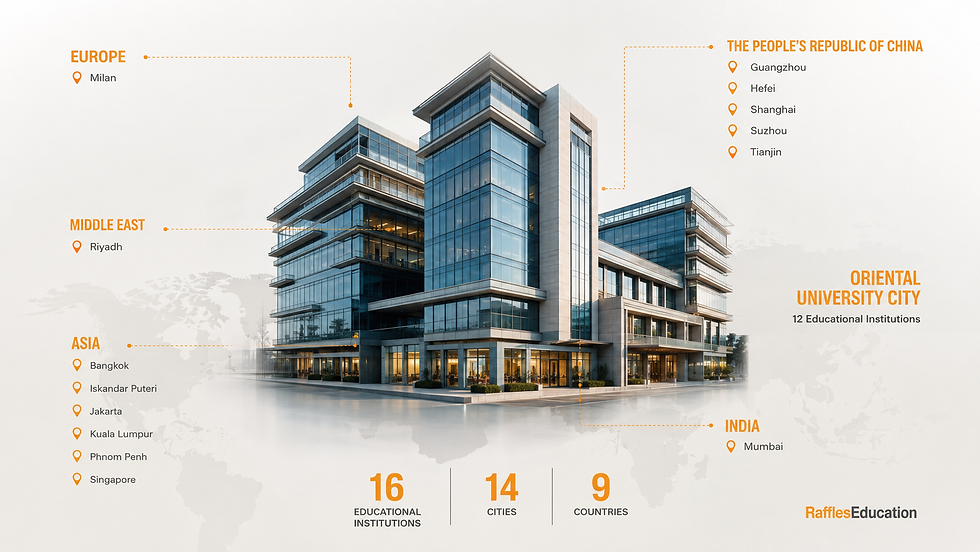
International benchmark. The campus sits within a network of 16 colleges and universities across nine countries, with cross-campus exchanges and competitions and progression routes overseas, including Singapore and Milan.
Why these forms of leadership are becoming more valuable
The trajectory of the labor market specifically favors this profile. The Future of Jobs Report 2025 by the World Economic Forum, based on data from over 1,000 employers in 55 economies, indicates that approximately 39 percent of workers' current skill sets will be altered or rendered obsolete from 2025 to 2030 (World Economic Forum, 2025a).
Employers prioritize skills such as analytical reasoning; adaptability with resilience and agility; leadership and social impact; and innovative thinking (World Economic Forum, 2025b).
Engaging in challenging tasks in authentic environments and receiving feedback develops these abilities, mirroring the process that yielded the aforementioned results.
The competitive environment instills a sense of immediacy.
In August 2025, Indonesia's open unemployment rate was recorded at 4.85 percent, equating to approximately 7.46 million individuals, with a notable 16.89 percent among the youth aged fifteen to twenty-four (Badan Pusat Statistik, 2025a; Tempo, 2025).
Graduates who can showcase their work instead of merely articulating their qualifications hold a significantly different status in that market.
The part that is not automatic
A sincere concluding remark. These represent personal accomplishments, rather than assurances from institutions. The aforementioned graduates participated in competitions, embraced the uncertainties of establishing ventures, welcomed challenging feedback, and consistently generated work instead of waiting until the conclusion.
An educational institution can provide the benchmark, the evaluation, the accessibility, and the prospects. However, it cannot instill the determination needed to act on those opportunities.
The record indicates that the path is established and has been traversed multiple times by individuals who were recent students, originating from a campus on Jalan M.H. Thamrin in Central Jakarta.
For individuals contemplating the feasibility of that path, the most pertinent evidence is not an assertion regarding results. The results themselves are published and verifiable.
Frequently Asked Questions
What have Raffles Jakarta alumni achieved internationally? Alumni and students have won the Mittelmoda Fashion Award in Milan, reached its 2025 finals as Southeast Asia's only representative, won the Harper's Bazaar Asia NewGen Fashion Award, and earned international recognition for artwork exhibited in competitions worldwide. One graduate was recognized in Forbes 30 Under 30 Asia in 2019 for entrepreneurial achievement.
Do Raffles Jakarta graduates start their own businesses? Yes. Published alumni outcomes include a fashion design graduate who founded PRSNL, a contemporary women's fashion brand, and a business administration graduate who drives growth at one company while co-owning another and founding a foundation.
A further graduate works internationally as a singer, entrepreneur, and recording artist.
What corporate roles do Raffles Jakarta alumni hold? Alumni hold decision-making roles inside established organizations, including Head of Retail Operations at Samsung Electronics Indonesia and, for an MBA graduate, a role supporting executive leadership and financial operations at one of Indonesia's leading online trading companies.
Do students achieve recognition before they graduate? Several do. Students have won Jakarta Fashion Week 2025, placed as first runner-up at Lomba Perancang Mode 2023, and gained international recognition for award-winning artwork while still enrolled.
Competitions provide a demanding external standard with a fixed deadline, which studios use as part of the teaching structure.
What do these alumni have in common? They produced work to a professional standard early, submitted it repeatedly to external judgement through critique, exhibitions, and competitions, and built a body of evidence rather than relying on credentials.
Teaching by practicing professionals and industry contact during study rather than after are the structural features behind this pattern.
Where is Raffles Jakarta located? Raffles Jakarta is located on Jalan M.H. Thamrin in Central Jakarta. It is part of Raffles Education, which operates 16 colleges and universities across nine countries in the Asia Pacific and Europe, with cross-campus exchanges and overseas progression routes that include Singapore and Milan.
Arman POUREISA Marketing Manager


References
Antara. (2025). Indonesia's creative economy beats jobs target in 2025. https://en.antaranews.com/news/396817/indonesias-creative-economy-beats-jobs-target-in-2025
Badan Pusat Statistik. (2025a). Tingkat Pengangguran Terbuka (TPT) sebesar 4,85 persen. https://www.bps.go.id/id/pressrelease/2025/11/05/2479/tingkat-pengangguran-terbuka--tpt--sebesar-4-85-persen--rata-rata-upah-buruh-sebesar-3-33-juta-rupiah-.html
Badan Pusat Statistik. (2025b). BPS: Creative economy employs 27.4 million workers in 2025. https://www.bps.go.id/en/news/2025/11/17/805/bps--creative-economy-employs-27-4-million-workers-in-2025.html
Bandura, A. (1977). Self efficacy: Toward a unifying theory of behavioral change. Psychological Review, 84(2), 191 to 215. https://pubmed.ncbi.nlm.nih.gov/847061/
BYU Design Review. (2025). How to create a design portfolio that drastically improves your job prospects. https://www.designreview.byu.edu/collections/how-to-create-a-design-portfolio-that-drastically-improves-your-job-prospects
Jackson, D., & Dean, B. A. (2023). The contribution of different types of work integrated learning to graduate employability. Higher Education Research & Development, 42(1), 93 to 110. https://www.tandfonline.com/doi/full/10.1080/07294360.2022.2048638
Kemenekraf. (2025). Minister of Creative Economy reports one year performance. https://ekraf.go.id/news-en/minister-of-creative-economy-reports-one-year-performance-creative-economy-contribution-to-national-gdp-reaches-rp1500-trillion
Mittelmoda. (n.d.). Winners of the 29th edition of the fashion award. https://mittelmoda.com/news/winners-29th-edition-fashion-award
Raffles Education. (n.d.). Raffles Institute of Higher Education Jakarta. https://raffles-iao.com/our_campus/raffles_institute_of_higher_education_jakarta/
Raffles Jakarta. (n.d.a). Alumni success stories. https://www.raffles-indonesia.com/alumni-success-story
Raffles Jakarta. (n.d.b). Programs offered. https://www.raffles-indonesia.com/programmes
Raffles Jakarta. (n.d.c). Business administration. https://www.raffles-indonesia.com/business-administration
Raffles Jakarta. (n.d.d). International academic team. https://www.raffles-indonesia.com/international-creative-practitioners
Raffles Jakarta. (n.d.e). Our worldwide campuses. https://www.raffles-indonesia.com/our-worldwide-campuses
Raffles Jakarta. (n.d.f). Raffles career development. https://www.raffles-indonesia.com/raffles-career-development
Raffles Jakarta. (n.d.g). Fashion marketing and management. https://www.raffles-indonesia.com/fashionmarketing
Raffles Jakarta. (n.d.h). Raffles fast tracked programmes. https://www.raffles-indonesia.com/raffles-fast-tracked-programmes
Shulman, L. S. (2005). Signature pedagogies in the professions. Daedalus, 134(3), 52 to 59. http://www.jstor.org/stable/20027998
Tempo. (2025). Angka pengangguran per Agustus 2025 tembus 7,46 juta orang. https://www.tempo.co/ekonomi/angka-pengangguran-per-agustus-2025-tembus-7-46-juta-orang-2086604
World Economic Forum. (2025a). The future of jobs report 2025. https://www.weforum.org/publications/the-future-of-jobs-report-2025/digest/
World Economic Forum. (2025b). Skills outlook: The future of jobs report 2025. https://www.weforum.org/publications/the-future-of-jobs-report-2025/in-full/3-skills-outlook/


