


How Does Raffles Jakarta Help You Define a Path?

A distinct hush envelops the atmosphere when a seventeen-year-old is asked about their aspirations for the future. The inquiry comes with significant gravity, typically from those who care deeply, and it necessitates an assured response at a time when such responses are most elusive. Moreover, the resolution is regarded as conclusive.
Decide now and inhabit that choice. The evidence contradicts this assertion, and it does so emphatically. Selecting a path is not merely a singular moment of revelation.
It is a procedure of experimentation, exploration, and modification, and the organizations that provide the greatest assistance are those that integrate this process into their framework rather than insisting on assurance from the outset.
How does Raffles Jakarta help you define a path?
Raffles Jakarta assists you in delineating a trajectory by rendering the decision evaluative instead of conclusive.
Before enrollment, the Find Your Path tool, open house events with academic teams, consultations with admissions, and a portfolio assessment for design candidates give prospective students clear insights about themselves and the available disciplines, instead of making them guess.
Upon enrollment, participation in live industry projects, internships, and instruction by seasoned professionals allows students to engage with real-world work early on, providing an opportunity to affirm or adjust their career trajectory at minimal cost.
Four admissions periods annually allow for a more measured decision-making process rather than a hurried choice within a single yearly timeframe, while a consortium of 16 institutions spanning nine nations facilitates subsequent redirection.
The route is established through empirical evidence obtained via action, rather than through a prior proclamation.
Why the decision goes wrong so often
The magnitude of misguided decisions merits explicit acknowledgment, as the majority of students perceive themselves as the sole individuals grappling with this issue. In Indonesia, the issue is referred to by a specific term.
A study conducted by the Indonesia Career Center Network revealed that 87 percent of Indonesian students recognized that their chosen programs did not align with their interests (iNews, 2020; Detik, 2021).
The repercussions follow students into their professional lives. Approximately 25 percent of graduates from higher education secure employment relevant to their area of study (Kompas, 2022), while a former minister of education estimates this figure to be as low as 20 percent; additionally, a distinct survey reveals that merely 13 percent of students believe they selected the appropriate program (Andika, 2022).
Data from the International Labor Organization in 2023 indicated that approximately 33.5 percent of higher education graduates are employed in sectors unrelated to their qualifications, with a vertical mismatch impacting about 57.3 percent of the workforce (NEXT Indonesia Center, 2026).
This scenario occurs in an already challenging market. In August 2025, Indonesia's open unemployment rate stood at 4.85 percent, equating to approximately 7.46 million individuals (Badan Pusat Statistik, 2025), with the rate for those aged fifteen to twenty-four soaring to 16.89 percent, significantly surpassing all other age demographics (Tempo, 2025).
The phenomenon is not exclusive to Indonesia. National longitudinal data in the United States indicates that approximately 30 percent of undergraduates alter their major during their initial three years, with around 10 percent making multiple changes.
A study involving 817 alumni revealed that 61 percent would alter their undergraduate major if given the opportunity, even though 82 percent characterized their college experience as a sound financial investment (BestColleges, 2023).
The predominant rationale provided was the desire to follow their passion, indicating that the initial decision was based on an entirely different criterion.
What actually predicts a good decision
In this context, the research is truly beneficial and somewhat paradoxical. Altering one's course is a success, not a failure.
An examination conducted by the Education Advisory Board revealed that students who determined their major between the second and eighth semesters achieved an 83 percent graduation rate, in contrast to 79 percent for those who made their decision in the first semester (University of Tulsa, 2026).
A comprehensive analysis involving tens of thousands of students revealed that individuals who were receptive to altering their academic trajectory had a higher graduation rate compared to those who made immediate decisions, and students who made choices as late as their fifth semester experienced no adverse effects on their time to degree completion (Inside Higher Ed, 2016).
The crucial requirement is that exploration needs to be organized. Unstructured drift incurs significant expenses: students who change their majors late often require more than four years to graduate or may not graduate at all, and the accumulation of non-transferable credits results in tangible financial burdens (Hechinger Report, 2021).
Investigators studying significant switching determined that educational institutions ought to cease discouraging it and, rather, incorporate it into program development via standardized course sequencing, interdisciplinary introductory experiences, and adaptable credit utilization, enabling students to reassess their objectives without falling behind (Leeds & Mokher, 2020). There is an additional discovery that merits retention.
A survey of 318 employers revealed that 93 percent prioritized critical thinking, communication, and problem-solving skills over a candidate's undergraduate major (EdSource, 2026).
The decision is significant, but it is not typically portrayed as disastrous. The selection pertains to an environment conducive to developing skills, rather than a permanent commitment.
Deciding before you enrol
Raffles Jakarta implements various mechanisms prior to the decision-making process rather than subsequent to it. The Find Your Path tool provides potential students with a systematic approach to refine their choices based on personal interests and strengths rather than relying on reputation or parental influence.
Engagements with the admissions team, accessible directly, transform an abstract decision into a concrete dialog regarding an individual's circumstances.
Open house events provide an experience that the brochure fails to deliver. Potential students engage with global academic teams, observe the operational campus atmosphere, inquire about admissions, scholarships, and career assistance, and collect the necessary information to determine if the institution aligns with their aspirations (Raffles Jakarta, 2026).
Engaging in conversation with the instructor in a studio setting serves as a superior assessment of compatibility compared to merely perusing a course outline.
The admissions procedure itself plays a role.
Candidates applying for design-related programs might be required to present a portfolio during the evaluation process, and compiling such a portfolio compels an individual to critically assess their creations and preferences.
Selection is determined by a comprehensive evaluation of the individual's capabilities and qualifications instead of relying solely on a singular metric, thereby accommodating individuals whose abilities may not be reflected in academic records.
For candidates who have not yet fulfilled the English proficiency criteria, an English as a Second Language program is available to ensure that a language deficiency does not silently obstruct their opportunities.
Testing the path once you are inside it
Pre-enrollment investigation can only assist a student to a certain extent. Individuals often lack clarity regarding their aspirations to become an interior designer, brand strategist, or hospitality manager until they have engaged in relevant tasks.
The Institute is the location of the most robust correction mechanism. Instruction is provided by global creative professionals actively engaged in their industries, allowing students to experience the authentic standards, dynamics, and challenges of a discipline from the outset, rather than merely an academic conceptualization of it.
The Center of Professional Development conducts live projects, industrial placements, industry research, and career advancement initiatives concurrently with academic studies, with the clear objective of integrating students into the workforce prior to graduation.
The value for path specification is exact. A student immersed in a genuine studio, agency, or hotel environment rapidly discerns if the everyday nature of that profession aligns with their preferences.
If it occurs, the dedication intensifies, and the subsequent years acquire significance. Should it not occur, the revelation presents itself sufficiently early to permit modifications while alterations remain cost-effective. Both results are favorable.
The revelation of a career mismatch post-graduation devastates professional trajectories, as illustrated by the Indonesian mismatch statistics.
Structure that permits revision
Two structural characteristics render revision pragmatic instead of merely theoretical. The initial item is the calendar. Raffles Jakarta conducts four enrollment sessions annually in January, April, July, and October, each accompanied by four graduation periods.
This approach subtly eliminates a source of poor choices. A student unprepared in one term can continue without delaying a year or making hasty commitments to prevent wasting time. Four decision points annually represent a significantly different scenario compared to a single one.
The second aspect is the extent of the unified domain.
The curricula encompass fashion design, fashion marketing and management, visual communication design, digital media design, interior design, business administration, the MBA, and tourism and hospitality management, as well as artificial intelligence and psychology.
These fields are interconnected rather than disparate, which is significant for individuals realizing that their genuine passion lies adjacent to their initial pursuits. A student interested in fashion might discover that their aptitude lies in marketing instead of design.
An individual pursuing visual communication might discover that digital media is more suitable. Transitioning between adjacent fields maintains previously acquired knowledge.
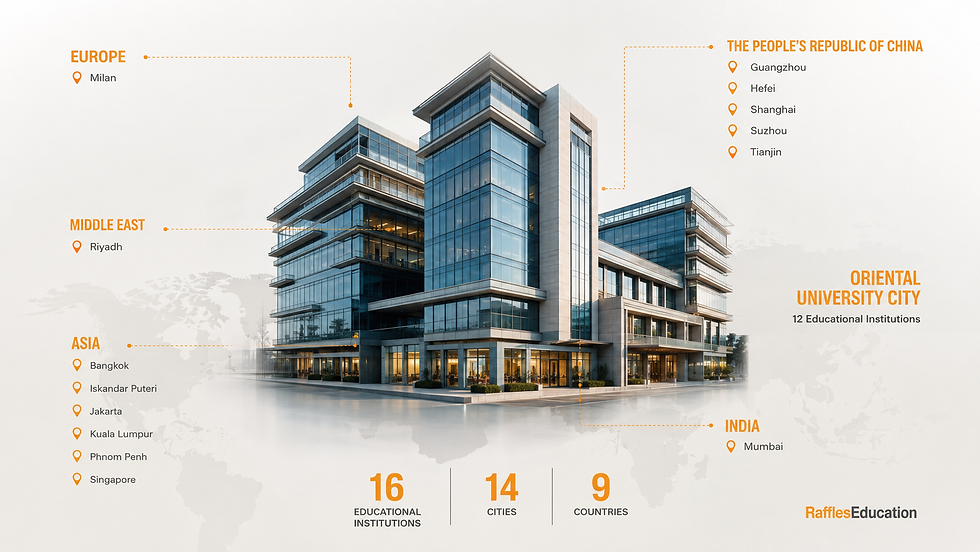
Raffles Education manages 16 institutions in nine countries across Asia Pacific and Europe, offering a flexible inter-school transfer program that allows students who complete Advanced Diploma studies to pursue Bachelor's Degree programs abroad, including in Singapore and Milan. A route established in Jakarta need not conclude there.
Seeing where paths actually lead
General guidance on discovering direction is not as beneficial as specific instances illustrating the paths taken. Raffles Jakarta transparently shares its alumni results, and the diversity is enlightening precisely due to its lack of uniformity.
Certain trajectories directly aligned with the field of study: alumni who secured the Mittelmoda Fashion Award in Milan, achieved first place at Jakarta Fashion Week, or advanced to the finals of the Harper's Bazaar Asia NewGen Fashion Award. Others were inclined.
A graduate in business administration built a career in manufacturing and printing and also created a foundation.
Another alumnus received acknowledgment in Forbes 30 Under 30 Asia. A Fashion Design alumna established her own label instead of aligning with a renowned fashion house. An MBA alumnus transitioned into executive assistance and financial management.
Analyzing these results constitutes a defining endeavor. They illustrate that a discipline serves as an initial pathway with multiple avenues, rather than a solitary passage, which represents the most precise perspective for a potential student.
The honest limits
No organization has the authority to define an individual's identity. A tool, a consultation, and an open house diminish uncertainty; however, they do not eradicate it.
Certain students may realize after a year that they selected a related discipline, and the appropriate reaction is adaptation instead of embarrassment, considering that approximately one-third of students universally reassess their decisions and do so to their advantage.
A school can justifiably assure that decisions will be informed rather than speculative, that the trajectory can be evaluated through actual professional experiences early on, that adjustments can be made without forfeiting prior investments, and that the skills developed will be esteemed by employers across various industries.
This process is the true representation of establishing a route on Jalan M.H. Thamrin in Central Jakarta. At seventeen, there is no expectation of immediate certainty, but rather a framework that allows for attaining it.
Frequently Asked Questions
What if I do not know which program to choose at Raffles Jakarta? Raffles Jakarta provides a Find Your Path tool, direct consultations with the admissions team, and open house sessions where prospective students meet the academic teams and see the campus before deciding. These tools replace guesswork with concrete information about both the disciplines and the school before you make any commitment.
Is it normal to be unsure about what to study? Being unsure is extremely common. National longitudinal data shows around 30 percent of undergraduates change major within their first three years, and a survey of graduates found 61 percent would change their undergraduate studies if they could go back. Research also indicates that students who remain open to revising their direction graduate at higher rates than those who commit immediately.
How common is choosing the wrong major in Indonesia? It is widespread. Research by the Indonesia Career Center Network found 87 percent of Indonesian students acknowledged their program did not match their interests, and only around 25 percent of graduates work in a field matching their studies. International Labour Organization data recorded roughly 33.5 percent of higher education graduates working in fields unrelated to their degree.
Can I change direction after starting a program? Direction can be revised. Raffles Jakarta offers adjacent disciplines across fashion, design, business, technology, and psychology, so a student discovering their strength lies in a neighboring field does not lose everything already learned. Beyond the Jakarta campus, a flexible inter-school transfer scheme operates across 16 institutions in nine countries, and Advanced Diploma graduates have overseas progression options, including Singapore and Milan.
How does industry experience help me define my path? Industry experience tests a career before you commit to it. Through the Center of Professional Development, students take part in live projects and industrial attachments alongside study and are taught by practicing professionals. Experiencing the actual daily work of a field early means that you can either confirm or correct your direction while the correction is still inexpensive.
When can I start at Raffles Jakarta? Raffles Jakarta has four intakes each year, in January, April, July, and October. Four entry points rather than one annual window means a prospective student is not forced to either wait a full year or commit before they are ready.
MARKETING MANAGER
References
Andika, C. B. (2022). Banyak pekerja salah jurusan: Apa yang harus diperbaiki di sistem pendidikan Indonesia? The Conversation. https://theconversation.com/banyak-pekerja-salah-jurusan-apa-yang-harus-diperbaiki-di-sistem-pendidikan-indonesia-173662
Badan Pusat Statistik. (2025). Tingkat Pengangguran Terbuka (TPT) sebesar 4,85 persen. https://www.bps.go.id/id/pressrelease/2025/11/05/2479/tingkat-pengangguran-terbuka--tpt--sebesar-4-85-persen--rata-rata-upah-buruh-sebesar-3-33-juta-rupiah-.html
BestColleges. (2023). New survey finds most college grads would change majors. https://www.bestcolleges.com/blog/college-graduate-majors-survey/
Detik. (2021). 87 persen mahasiswa RI merasa salah jurusan, apa sebabnya? https://www.detik.com/edu/detikpedia/d-5828770/87-persen-mahasiswa-ri-merasa-salah-jurusan-apa-sebabnya
EdSource. (2026). For many college students, picking a major takes time and revising. https://edsource.org/2026/college-students-changing-majors/751462
Hechinger Report. (2021). Switching majors is adding time and tuition to the already high cost of college. https://hechingerreport.org/switching-majors-is-adding-time-and-tuition-to-the-already-high-cost-of-college/
iNews. (2020). Survei: 87 persen mahasiswa di Indonesia salah jurusan. https://www.inews.id/news/nasional/survei-87-persen-mahasiswa-di-indonesia-salah-jurusan
Inside Higher Ed. (2016). Study finds students benefit from waiting to declare a major. https://www.insidehighered.com/news/2016/08/24/study-finds-students-benefit-waiting-declare-major
Kompas. (2022). Hanya 25 persen mahasiswa Indonesia yang bekerja sesuai jurusan kuliah. https://www.kompas.com/edu/read/2022/09/01/144623571/hanya-25-persen-mahasiswa-indonesia-yang-bekerja-sesuai-jurusan-kuliah
Leeds, D. M., & Mokher, C. G. (2020). Major decision: The impact of major switching on academic outcomes in community colleges. Research in Higher Education. https://link.springer.com/article/10.1007/s11162-020-09608-6
NEXT Indonesia Center. (2026). Potret dunia kerja RI: Cuma 40 persen bekerja sesuai pendidikan. https://nextindonesia.id/Update/2026/05/17/264/Potret-Dunia-Kerja-RI:-Cuma-40-Persen-Bekerja-Sesuai-Pendidikan
Raffles Education. (n.d.). Raffles Institute of Higher Education Jakarta. https://raffles-iao.com/our_campus/raffles_institute_of_higher_education_jakarta/
Raffles Jakarta. (n.d.a). Find your path. https://www.raffles-indonesia.com/find-your-path
Raffles Jakarta. (n.d.b). Enquiry form. https://www.raffles-indonesia.com/enquiryform
Raffles Jakarta. (n.d.c). Frequently asked questions. https://www.raffles-indonesia.com/faq
Raffles Jakarta. (n.d.d). Admission policy. https://www.raffles-indonesia.com/admission-policy
Raffles Jakarta. (n.d.e). Raffles career development. https://www.raffles-indonesia.com/raffles-career-development
Raffles Jakarta. (n.d.f). Raffles fast tracked programmes. https://www.raffles-indonesia.com/raffles-fast-tracked-programmes
Raffles Jakarta. (n.d.g). Programs offered. https://www.raffles-indonesia.com/programmes
Raffles Jakarta. (n.d.h). Our worldwide campuses. https://www.raffles-indonesia.com/our-worldwide-campuses
Raffles Jakarta. (n.d.i). Alumni success stories. https://www.raffles-indonesia.com/alumni-success-story
Raffles Jakarta. (2026). Exploring opportunities at Raffles Jakarta. https://www.raffles-indonesia.com/post/exploring-opportunities-at-raffles-jakarta
Research.com. (2026). How many students change majors? https://research.com/student-guides/choosing-a-major/how-many-students-change-majors
Tempo. (2025). Angka pengangguran per Agustus 2025 tembus 7,46 juta orang. https://www.tempo.co/ekonomi/angka-pengangguran-per-agustus-2025-tembus-7-46-juta-orang-2086604
University of Tulsa. (2026). Normalizing the norm of changing college majors. https://utulsa.edu/news/normalizing-the-norm-of-changing-college-majors/


