Is an MBA Still Worth It in the Age of AI?

Rina, a brand manager in Jakarta, is considering an MBA. But as she works on her application, a headline about employers valuing AI skills makes her pause. Would a business degree help her take the next step in her career, or would focused AI training be a better investment?
Rina is an illustrative character, but her dilemma raises a practical question: is an MBA still worth it in the age of AI? For working professionals, the decision involves time, cost, and the skills they need for the roles they want.
This article examines employer expectations, how business schools are responding to AI, and what to consider when choosing an MBA. The aim is to help you assess how a program could fit your career goals—and whether it is the right next step for you.
What Employers Want from MBA Graduates Today
Headlines comparing AI skills with an MBA can make the choice sound straightforward. Bloomberg reported that, in a 2026 PwC survey of more than 1,000 US financial services executives, 86% considered AI training more valuable than an MBA for many new hires. That finding matters, but it reflects one industry in one country—not every employer’s view of business education.
GMAC’s 2026 Corporate Recruiters Survey offers a broader perspective, drawing on 621 recruiters across 39 countries. Employers expressed continued confidence in graduate business education while placing greater importance on AI skills, data analysis, and adaptability. Yet half of employers surveyed considered graduates only somewhat prepared, not very prepared, or unprepared to use AI tools in their organizations.
For prospective MBA students, the useful question is what a program will help them do with that technology. Can they evaluate an AI-generated recommendation, interpret the evidence, and explain a decision to their team? When comparing programs, look for opportunities to practice those skills alongside finance, strategy, and management.
How Much Should MBA Rankings Influence Your Choice?
MBA rankings can help you build a shortlist, but they do not always agree. In 2026, MIT Sloan topped the Financial Times Global MBA Ranking, Stanford led the U.S. News ranking of full-time MBA programs in the United States, and Wharton placed first in GMAT Club’s combined ranking. Each list has a different scope and methodology, so its results need context.
Rankings also tell only part of the curriculum story. An April 2026 analysis reported by Poets&Quants identified 30 AI-related courses at Stanford, compared with 15 at Wharton and five at Harvard. These counts indicate availability, rather than teaching quality or what every student will learn. Meanwhile, GMAC’s 2026 prospective student research highlights cost concerns and demand for practical AI learning alongside strategy, communication, and business analytics.
Use rankings as a starting point, then assess what you need from the degree. Which courses can you take, how will you apply the learning, and can you manage the schedule and total cost? Those answers help you judge whether a program fits your career goals and circumstances.
How Business Schools Are Adapting in the AI Era

Business schools are responding to changing employer expectations by connecting AI with management education. The focus extends beyond learning to use tools: students also need to understand how AI affects business decisions, teams, and responsibilities.
Wharton introduced its Artificial Intelligence for Business MBA major in fall 2025, combining technical understanding with the technology’s business, social, and ethical implications. IESE took a different approach, integrating AI across first-year courses and learning activities from the 2026–2027 academic year. Its redesigned MBA addresses how managers can assess AI outputs, redesign workflows, and make strategic decisions.
For prospective students, these examples offer a practical question: how will you apply AI during the program? Look for opportunities to test recommendations, discuss risks, and explain decisions through business cases and projects. That gives you more to assess than the number of AI courses alone.
What Can Engineers and Entrepreneurs Gain from an MBA?
For engineers considering management roles, an MBA can complement technical expertise with knowledge of finance, strategy, and leadership. Building a tool and deciding whether a business should invest in it involve different questions: What problem will it solve? What will it cost? How will teams use it? The value depends on which responsibilities you want to take on next.
For entrepreneurs, the appeal may lie in developing a broader understanding of finance, marketing, and operations, alongside opportunities to exchange ideas with classmates. Business cases and projects can also provide space to examine challenges beyond the demands of running a company day to day.
Neither path makes an MBA an automatic requirement. Before committing, ask: what will this program help me do that I cannot do confidently now? Compare the answer with the time, cost, and other learning options available to you.
Exploring the Raffles Jakarta MBA While Working
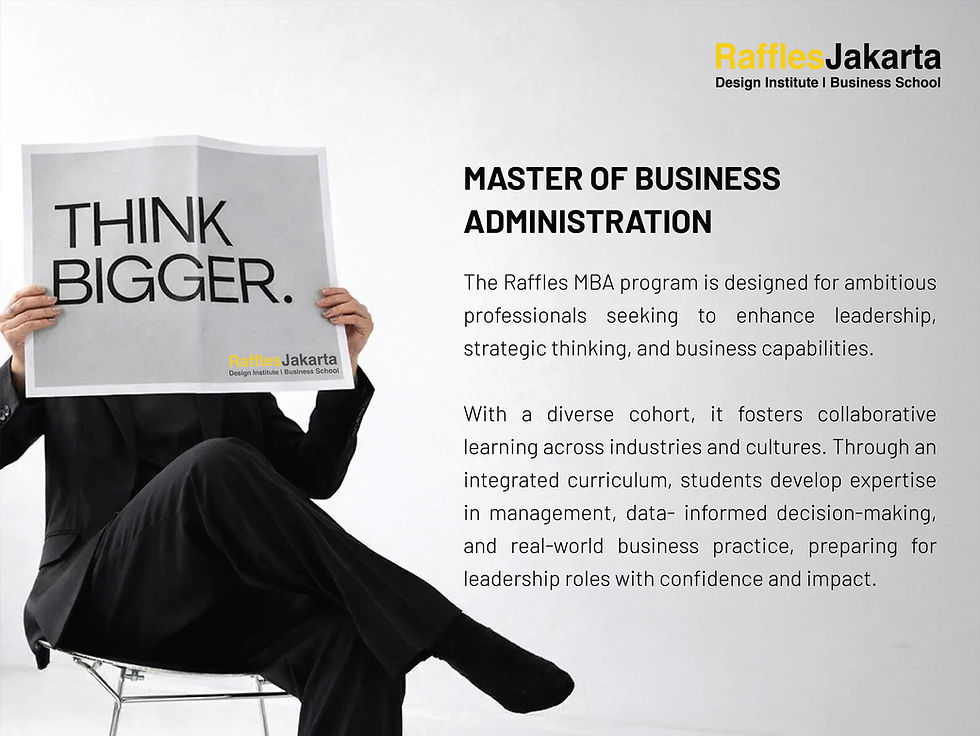
For professionals like Rina, choosing an MBA means finding a program that fits both career ambitions and everyday commitments. The Raffles Jakarta MBA offers a one-year program in Central Jakarta, with four intakes a year and on-campus or hybrid study options.
The program covers strategy, finance, leadership, and decision-making. Consider how these areas connect to the responsibilities you want to take on next. Before applying, discuss the timetable, workload, fees, and current curriculum with admissions, including how AI is addressed in the learning experience.
Frequently Asked Questions
Is an MBA still worth it in the age of AI?
An MBA can be worthwhile if its curriculum, cost, and study format support your career goals. Consider how it develops management knowledge and gives you opportunities to apply technology to business decisions.
Should I choose an MBA or a short AI course?
It depends on what you want to learn. A short AI course may suit a specific skills gap, while an MBA covers broader areas such as finance, strategy, and leadership. Compare the actual curriculum and time commitment of each option.
Do I need coding skills to benefit from an MBA?
Requirements vary by program, so check with admissions. Learning to evaluate AI recommendations and make business decisions involves different skills from developing the technology itself. Technical electives may have additional prerequisites.
Can I study for an MBA while working?
Some programs offer schedules and formats suited to working professionals. Raffles Jakarta advertises on-campus and hybrid MBA options. Ask about attendance requirements, weekly workload, and the timetable before deciding whether it fits your commitments.
Does the Raffles Jakarta MBA include AI courses?
Confirm the current curriculum with admissions. Ask which modules address AI, how students use it in projects, and whether those learning activities are required or optional.
An MBA can still be a worthwhile investment in the age of AI, but its value depends on what you need to learn and how the program supports those goals. Look for a curriculum you can apply, a schedule you can manage, and a cost you can plan for.
Want to explore your options? Visit the Raffles Jakarta Open House on Saturday, 28 November 2026, to meet the academic team and discuss your study plans.
If you are considering the January 2027 intake, book a consultation to confirm the MBA’s start date, study format, and application requirements.
Maria Rosliana Integrated Digital Marketing Executive Raffles Indonesia
References
Constantz, J. (2026, August 3). AI skills are more valuable than MBAs, 86% of finance executives say. Bloomberg News. https://news.bloomberglaw.com/us-law-week/ai-skills-more-valuable-than-mbas-86-of-finance-executives-say
Ethier, M. (2026, April 28). Stanford GSB leads MBA programs in AI course offerings, with Darden & Wharton close behind. Poets&Quants. https://poetsandquants.com/2026/04/28/stanford-gsb-leads-mba-programs-in-ai-course-offerings-with-darden-wharton-close-behind/
GMAT Club. (n.d.). MBA rankings. https://gmatclub.com/mba-rankings
Graduate Management Admission Council. (2026a). Corporate Recruiters Survey: 2026 report. https://www.gmac.com/market-intelligence-and-research/market-research/corporate-recruiters-survey
Graduate Management Admission Council. (2026b). GMAC Prospective Students Survey: 2026 report. https://www.gmac.com/market-intelligence-and-research/research-library/admissions-and-application-trends/2026-gmac-prospective-students-survey-report
Graduate Management Admission Council. (n.d.). US News MBA ranking 2026: Best business schools in the USA. https://www.gmac.com/resources/learners/business-programs/explore-programs/best-business-schools-in-usa
IESE Business School. (n.d.). Master in Business Administration program. https://www.iese.edu/mba/program/
MIT News. (2026, March 13). The Financial Times ranks MIT Sloan No. 1 in the 2026 Global MBA Ranking. https://news.mit.edu/2026/financial-times-ranks-mit-sloan-no-1-global-mba-ranking-0313
Raffles Jakarta. (n.d.). Think bigger: The Raffles Jakarta MBA 2026. https://www.raffles-indonesia.com/